
Udinese’s roots can be traced all the way back to 1896, making it one of Italy’s oldest clubs. However, it was a further 15 years before the city’s multi-sports society established a dedicated football section. Today, the club brands itself as the first Italian club to wear black and white, neatly steering clear of any contention about their exact age whilst aiming a poke in the eye of Italy’s more famous black-and-white club.
The first century of Udinese’s footballing endeavours could be fairly described as undulating. Le Zebrette oscillated between Serie A and Serie C before they became embroiled in a match-fixing scandal in 1955. They then fell into the semi-professional strata, where a triumphant Anglo-Italian Cup campaign in 1977/78 pitted them against the likes of Maidstone, Wealdstone and Minehead. The 1980s saw their return to Serie A, where they momentarily ruffled the feathers of the Italian football hegemony with the shock signing of Brazilian superstar Zico from under their rivals’ noses.
However, it was a Friulian industrialist rather than a Brazilian magician that irreversibly changed the club’s fortunes. The arrival of present owner Giampaolo Pozzo in the late 1980s was a watershed moment for Udinese. His long-term vision for the club laid the foundations for the Udinese we know today. At the heart of his strategy was a pioneering recruitment plan that brought simultaneous success both on the pitch and the balance sheet. Udinese were amongst the first to adopt modern analytical techniques (the video analysis suite at their HQ is legend) and a global network of scouts, unearthing gems in the backwaters of Europe, Africa and South America.
Udinese became the entry point to Europe for players such as Nestor Sensini, Marcio Amoroso, Sulley Muntari, Alexis Sanchez, Juan Cuadrado and Luis Muriel. These players arrived as unknowns and were all sold on at a handsome profit. As the business model became proven and Udinese established themselves at the top table of Italian football, rival clubs clamoured to replicate their approach. Udinese’s Champions League adventures (2011-2013) have become a more distant memory, but their on-going 27-year stay in Serie A remains a remarkable feat for an unfashionable provincial club.
The city of Udine is characterised by the most breathtaking Alpine backdrop. It is perennially in view, and when lit by golden winter sunshine, the infinite snow-capped peaks could be mistaken for a film set. But this pristine beauty belies a rather grim history. This mountainous area of Italy, located close to the Austrian and Slovenian borders, was the frontier for bloody exchanges during the First War World. For those inclined to explore, there are a wealth of wartime relics etched into the arduous landscape.
Udine is home to just 100,000 people, although, with no local rivals to speak of, Udinese act as a focal point for the wider Friuli region. In the city itself, Slavic and Austrian influences can be seen in Udine’s architecture, the cuisine and the more reserved demeanour of the locals; it’s Italy but not as you will have experienced it elsewhere. Castello di Udine is located in the centre and offers a fantastic vantage point over the city and to the mountains beyond.
The Anconadue restaurant is a bit of a local secret; located in a commercial area about 3km north of the centre its off the tourist track. The food is fantastic and the walls inside are adorned with the most incredible collection of signed football shirts – and several Udinese players are known to frequent it too. Just up the road from the restaurant is Hotel Là di Moret where visiting teams often stay.
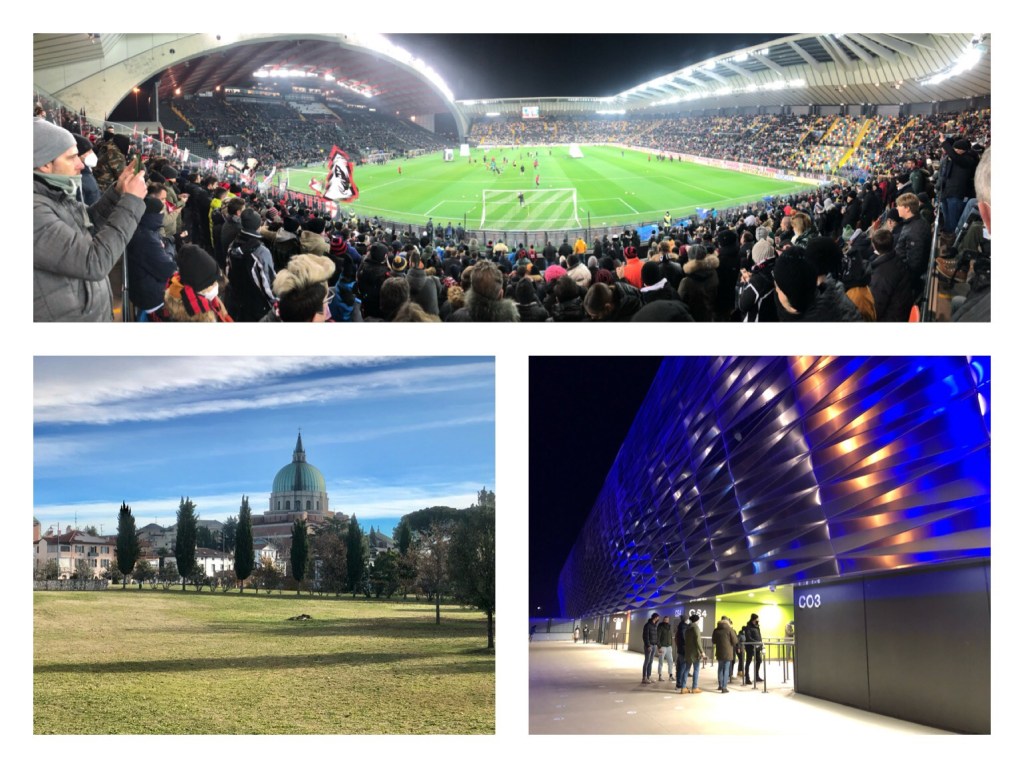
The club left their former Stadio Moretti home in 1976. It was a venue gifted to the municipality by the famous Moretti brewery and one which doubled as a speedway track! The new Stadio Friuli was an out-of-town arena intended to service the growing ambitions of the club. It was designed by Giuliano Parmegiani and Lorenzo Giacomuzzi Moore (born to an English mother), taking inspiration from the vast open bowl of the 1972 Olympic Stadium in Munich.
The defining feature of the stadium – an elliptical arch spanning the main tribuna – was faithfully preserved when the stadium was almost entirely redeveloped between 2013 and 2016. Three sides of the stadium were flattened, the athletics track removed and the stands brought closer to the pitch. The pleasing result is a modern stadium fit to grace any one of Europe’s top leagues. The stadium tour is highly recommended, but runs infrequently, so worth checking availability in advance here.
The growth of Udine’s suburbs means that the renamed Bluenergy Stadium is less out-of-town than it once was, but it’s certainly worthwhile planning your route to the stadium in advance. My decision to walk from my hotel in the north of the city was blighted by a series of unlit and precarious rural roads. Most fans seem to drive and park in the vast car parks surrounding the stadium. Alternatively, a taxi from the centre costs around €15.
Obtaining tickets for Udinese matches is generally not problematic with an ample 25,000 capacity. The only exception to this would be the matches against Inter, Milan and Juventus where you should be primed to buy tickets once they go on general sale via (ticketone.it). I visited for the game against Milan (2021) and it quickly became apparent that the supposed ‘home’ section of the south curva was in fact dominated by visiting Milanisti.
After that precarious walk to the stadium, there were significant queues to get in due to the larger-than-normal crowd. Inside the ground, there was a run-of-the-mill bar and refreshments counter, which seemed exceptionally busy. Even for a quieter game, it’s worth knowing that they operate a double-queuing system where you first have to pay and then queue again to collect what you’ve bought.
A monthly Udinese club magazine was advertised on the concourse, but not sold in that part of the stadium (try any local tabaccheria or newsstand for this, excellent value at €2.50). The club shop is located inside the perimeter gates at the north end of the stadium, so it can only be accessed on matchday if you have tickets in that part of the stadium.
I returned in 2023 and took up a hospitality ticket in the Executive Club. For around €150, you get a padded seat in the main tribuna, a high-end buffet (I’m now fully converted to San Daniele prosciutto) before, during and after the match, with drinks (beers, wines, soft drinks) included.

For the Milan game (December 2021), caretaker coach Gabriele Cioffi was in the Udinese dugout for the first time; a man whose previous coaching assignment was at Crawley Town. His charges took an unexpected lead early in the first half through Beto. The Portuguese forward, a rough diamond reminiscent of those signings from the 2000s, bustled his way through to silence the travelling Milan tifosi.
From that point, Milan dominated proceedings but produced few clear-cut chances as they tried to force their way back into the game. Despite Milan’s impotence, there was an air of inevitability about their eventual injury-time equaliser. Zlatan Ibrahimovic, surrounded by defenders in the six-yard box, swivelled to unleash an acrobatic shot into the hosts’ net.
As a city, Udine certainly offers something different for the Italian groundhopper. The main obstacle remains its isolated location, with no direct flights and several hours by road or train to the nearest hub cities of Venice or Verona. However, there is certainly scope for a groundhopping itinerary also comprising Triestina and Pordenone in the far northeast, or Venezia, Padova, Cittadella and Vicenza if willing to travel a little further west.
Thanks for reading. If you enjoyed this, check out our other calcio travel guides here.


 Calcio England
8 Comments