
Welcome to our travel notes for Hellas Verona – part of our on-going series covering stadia and cities across Italy.
The City
Verona’s civic splendour owes much to the Scaligeri family. In the 13th century, they rebuilt the Roman city which had been devastated by an earthquake. Then, through a combination of diplomacy and brutality, they expanded their realm to encompass swathes of modern-day Lombardia, Tuscany and Friuli, transforming Verona into one of Europe’s most prosperous city-states.
Although Fair Verona provides the backdrop for two of William Shakespeare’s masterpieces, it is unlikely that The Bard ever visited the city. His choice of location was a narrative device, a reference to the stereotypical passion of the Italian people and their proclivity for violence.
It was some two hundred years before Shakespeare that Dante Alighieri initiated Verona’s reputation as a cradle for the literary arts. And some two hundred years after that the likes of Goethe, Byron, Shelley and Keats frequented the city on their Grand Tours.
Today, a typical tourist itinerary might begin with a coffee in Piazza Bra, taking in the elegant cedar trees and the majestic Roman Arena. Perhaps followed by a stroll through the meandering streets of old Verona towards Piazza delle Erbe and the fictitious scene of Juliet’s balcony.
Naturally, the Veneto region has a distinct culinary style, which includes the Veronese delicacy of Rissotto all’Amarone (made with Valpolicella wine, giving it an unusual dark red hue). For the more adventurous, Pastissada de Caval is a stew made with horse meat that divides opinion, even amongst locals. Specific recommendations made to me by Verona resident Rick Hough include Osteria il Ciottolo (Corso Cavour) and Trattoria La Molinara (Via Ottolini)
I would usually aim to stay clear of political commentary in a travel guide, but it would be remiss not to mention that a former Italy international and Hellas Verona player is the city’s Mayor. Damiano Tommasi, a player renowned for his strong moral compass and dedication to social causes during his playing days, overturned several decades of right-leaning politics in the city when elected as head of a centre-left coalition in 2022.

The Club
Verona’s footballing ancestry can be traced back 120 years to a group of students from the city’s Scipione Maffei school. They adopted the Greek nomer, Hellas, in homage to their Classics professor. The modern club colours of blue and yellow are taken from the city’s coat of arms, whilst the mastiffs featured on the club crest are a nod to previous heads of the Scaligeri family, Mastino (mastiff) and Cangrande (Big Dog).
Hellas have spent the lion’s share of their history in Italy’s second tier, with occasional excursions up and down the pyramid. Their undoubted high point came in 1985 with a miraculous Scudetto triumph. Although I Gialloblu defied the odds in overcoming the Italian football hegemony, it was no flash in the pan.
Coach Osavaldo Bagnoli led Verona to Serie A in 1982 and finished 4th and 6th in the following campaigns. The arrival of Hans Peter-Briegel and Preben Elkjaer in the summer of 1984 (but only after failing to tempt Gordon Strachan from Aberdeen) proved to be the missing ingredients as Bagnoli served up Verona’s first and, to date, only title.
Perhaps owing to the city’s invasive tendencies of the past, Hellas Verona have a long roll call of declared rivals. To the west, the Lombardian mainstays of Milan, Inter, Atalanta and Brescia are seen as enemies (all located within 75 minutes by train). To the east the intra-regional rivalries with Vicenza and Venezia burn fiercely. Curiously, there is no great rivalry with upstarts Virtus Verona (Serie C), despite clear dividing lines in the politics of the respective fan groups. Virtus could yet graduate from their status of annoying sibling if and when they find themselves in the same league.
Hellas Verona’s popularity amongst an Anglophone audience owes a great deal to Tim Parks’ cult book, A Season With Verona. The author follows the fortunes of the club as they battle for Serie A survival in the 2000/01 season. Parks’ insightful and engaging journey into football, fandom and Italian culture left an imprint on a new generation of Italian football enthusiasts. He and Verona even obliged with a happy ending; Verona won a nail-biting play-off to preserve their Serie A status.
Three of the protagonists from Parks’ epic – Massimo Oddo, Alberto Gilardino and Mauro Camoranesi – would go on to win the 2006 World Cup with Italy. Over the years, Verona has played host to household names such as Pippo Inzaghi, Angelo Peruzzi and Paolo Rossi. A host of British players have pulled on the Hellas Verona jersey, including Joe Jordan, Liam Henderson, Craig Davies, Josh Doig and Ronaldo Vieira.
The Stadium
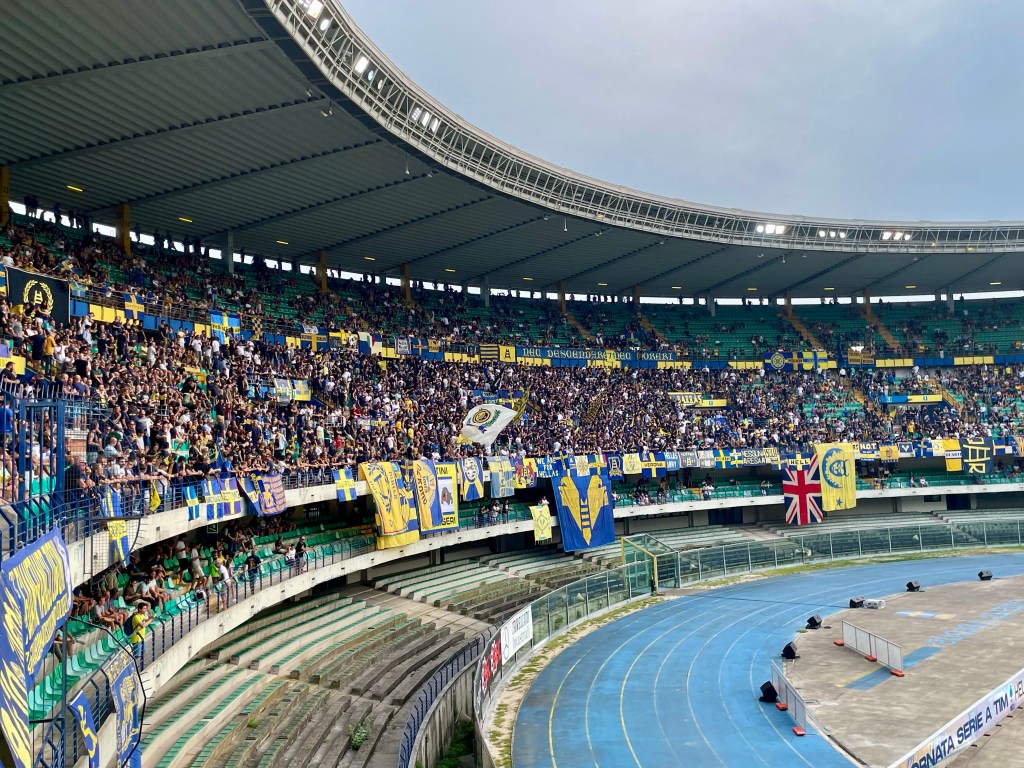
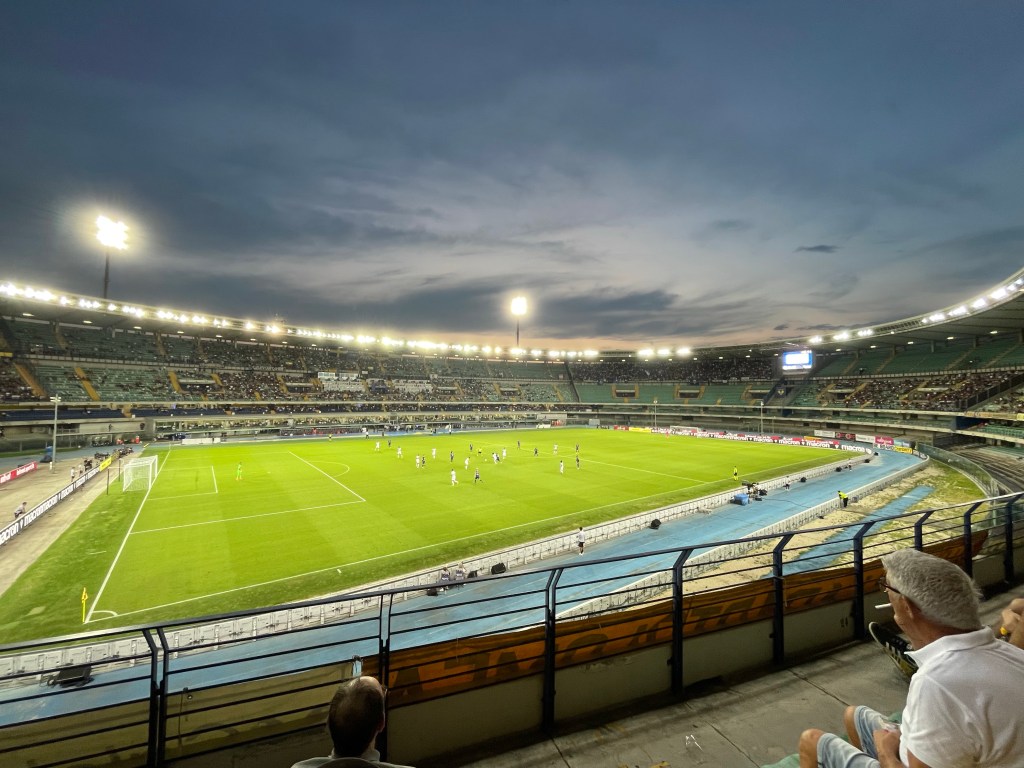
On the one hand, Stadio Marc’Antonio Bentegodi stands as a monument to Italian football’s failure to keep pace with the rest of Europe. Squinting supporters are located beyond a rarely used athletics track. The venue lacks the corporate and commercial facilities that became integral to modern stadium design soon after Italia ‘90. It is in a dilapidated state with sections of the stadium out of bounds and generally not the sort of place you’d take someone you were trying to impress.
On the other hand, the Stadio perfectly embodies the rudimentary beauty of calcio. Just as their ancestors had done at the other Arena, this is a place where the people of Verona congregate. Young and old, rich and poor coming together to renew their connection with one another and their city. On matchday, this decrepit edifice is suddenly transformed into the beating heart of the city. As a visitor, ninety minutes spent here provides a glimpse into the soul of Verona.
Constructed in the 1960s, Stadio Bentegodi originally provided uncovered accommodation for 40,000 spectators. An overhaul in preparation for the 1990 World Cup saw the addition of an extra tier of seating and a continuous roof, taking the capacity to 47,000. In 2009, an array of solar panels was fitted to the roof, the revenues from which offset the annual maintenance costs of the stadium. Hellas are now the sole tenants following the demise of upstarts Chievo Verona in 2021.
You will not be surprised to discover that there has been talk of a stadium rebuild in recent years. And even less surprised to hear that no tangible progress has been made.
Matchday
There are two club shops in the city centre; the flagship store is located just off Piazza Bra on Via Carlo Cattaneo. For those on a budget, the club also have an outlet store selling previous seasons’ merchandise, located about 1km south of the centre (Via Franco Faccio). The club also operates several smaller merchandise outlets just beyond the turnstiles on matchdays.
From the historic centre, the stadium is a pleasant 30-minute (2.5km) walk through Verona’s inner suburbs. I made a spontaneous decision to hire a Lime e-scooter which, for the price of a few Euros and a small incremental risk of injury, cut the journey time to just a few minutes.
The southern end of the stadium is where supporters gather ahead of kick-off, so this is the place to head to imbibe the pre-match atmosphere. There are several bars and cafes in the streets immediately adjacent to the stadium (for example, Nilla Café). Alternatively, you can find the usual plethora of chrome-clad wagons selling beer, sandwiches and chips on Via Fra Giocondo.
I bought match tickets for the fixture against Atalanta from vivaticket.com around ten days before the game. Availability of tickets is certainly not a problem, though tickets for the Curva Sud – preserve of the Hellas ultras – were not available on general sale. I opted for a ticket in the Poltrone Est (sector 8, closest to the Curva Sud). I paid €27.50 and my son’s ticket was a bargain at just €2.
Hellas fan groups have a long-standing connection to British fan culture and an affiliation with Chelsea, in particular. This association was visibly manifested through a large Union Jack draped from the middle tier of the curva. Even armed with this prior knowledge, it was a curious experience for a British visitor to hear an augmented rendition of God Save The Queen belted out during the second half.
The vibrance and energy of the home supporters – as described in Tim Parks’ text – certainly did not disappoint. The Curva Sud was a heaving mass of yellow and blue. Each district of the city was seemingly represented by a banner or flag. Their support was loud, rhythmic and relentless; through the sheer will of the Curva alone, Hellas came within a whisker of salvaging a point against their local rivals Atalanta.
If you enjoyed this, check out our Italian football travel guide, packed with hints and tips to make the most of your trip.


 Calcio England
5 Comments