
Empoli is not typically regarded as one of the pearls of the Tuscan necklace.
Located betwixt two of the region’s tourist honey pots, the tower-ogling tourists in Pisa pass directly through Empoli in on their way to the overflowing cultrual cup of Florence. Existing in the shadow of its glamourous neighbours, Empoli is little more than a dot on a train line to these transient hordes.
Niether would it be controversial to suggest that Empoli also lacks the medieval charm of Tuscany’s smaller walled cities, such as Lucca and Siena. It is, by local standards, a somewhat non-descript place. That’s to say its 1,000-year-old marbled basilica contains only a limited range of Renaissance artwork.
With a population of around 50,000, Empoli serves as a focal point for the neighbouring comunes. The Arno River flows through the town en route from the Appenines to the Mediterranean and tells the story of the rather functional role that Empoli once played as a gateway to the surrounding agricultural lands.
Whilst this part of Tuscany is today synonymous with vinyards, it is the humble Carciofo Empolese – a thornless variety of artichoke – that takes its name from the town.

The Club
Empoli Football Club were formed in 1920 through a merger of two local teams. The new entity climbed their way through the Tuscan leagues, during which time the ruling political regime enforced a series of name changes. These fleeting identities ranged from the distasteful (Associazione Sportiva Fascista Empoli) to the ridiculous (Dopolavoro Interaziendale Italo Gambacciani Sezione Calcio) before returning full circle.
Recent decades have undoubtedly marked a high point for a club which has spent the majority of its existence in the semi-professional ranks. It was an aspiring young coach by the name of Luciano Spalletti who elevated Empoli from the third tier to Serie A in the mid-1990s and they’ve alternated between the top two divisions ever since.
Empoli’s trophy cabinet is furnished with the spoils from three Serie B championships, all of which have been achieved since the Millennium. Their most recent, and somewhat unlikely, triumph came at the junior level when their Primavera team were crowned champions of Italy (2020/21). The senior team have competed in European competition on one occasion, when a seventh-place finish in 2006/07 earned them qualification for the UEFA Cup.
Club icons include Antonio Di Natale, who struck 55 goals in the Azzurri shirt after graduating through their youth ranks. Some-time Teesside resident Massimo Maccarone distinguished himself by scoring a century of goals across two spells with the club. But the highest regard is reserved for all-time top scorer Francesco Tavano, the one-time strike partner of Maccarone, who amassed 120 goals for Empoli.
The Stadium
Stadio Carlo Castellani is named after a former striker who tragically perished at the Mathausen concentration camp in 1944. Castellani had heroically taken the place of his frail father when the Fascist regime descended upon his village to round up dissenters.
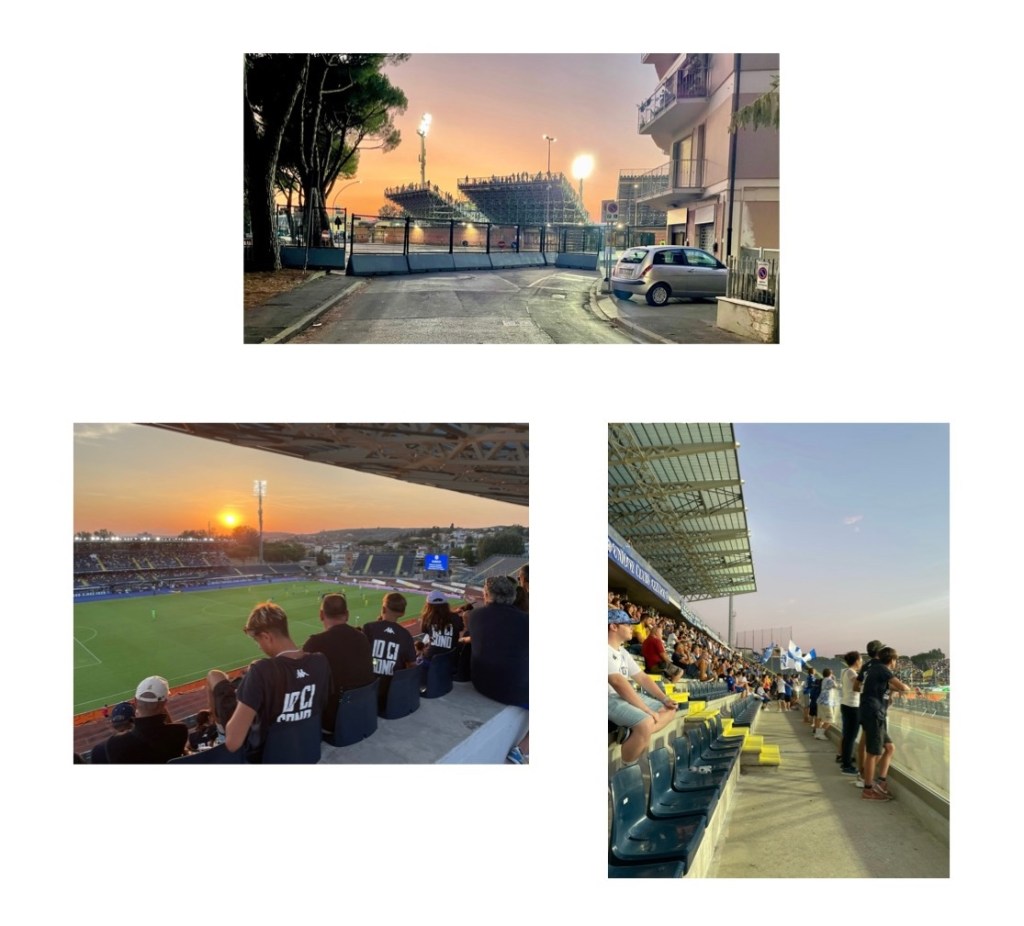
The stadium is located on the north-eastern edge of the town centre, just a 15-minute walk from the railway station that sits on the line Pisa-Florence line. Built in 1965, the stadium was originally comprised solely of a main tribune, but the capacity was expanded in line with Empoli’s burgeoning fortunes. In 1990, the Maratona stand was constructed opposite the tribuna, to which a cantilever roof was added in 2009.
Behind each goal, located beyond the athletics track, are a series of scaffold structures. Unusually, Empoli’s ultras take up a position in the lower part of the Maratona stand, rather than in the Curva. They moved here in 1997 at the request of Luciano Spalletti, who wanted to create a more intense atmosphere.
In 2018, plans were unveiled to rebuild the stadium, removing the athletics track and rebuilding three sides to provide an enclosed arena. However, these plans have not mvoed forwards.
The Match
Empoli have a modest but loyal support base; a typical home match in Serie A might attract 7-8,000 fans, meaning tickets are easy to secure. The exception to this is matches against Juventus, Milan, Inter and Fiorentina, when the attendance will converge upon the 16,000 capacity limit.
For the 2023/24 season-opening encounter with Hellas Verona, we purchased tickets via ticketone.it. We had to be patient though; tickets were released on general sale just three days before the match took place. We bought tickets for the upper Maratona, priced at €25 (or €20 for women and children).
I was pleasantly surprised to find a matchday programme distributed free-of-charge just inside the turnstiles; Empoli must now be one of the few clubs in Italy to produce a physical programme. However, they were not printed in great quantities and the bundles were exhausted long before the stadium started to fill up.
Once inside, we spotted the ultra groups selling a limited range of unofficial merchandise (e.g. t-shirts, scarves) on the concourse. There didn’t appear to be an official merchandise outlet at the stadium; the club shop is located in the town centre in Piazza della Vittoria (be aware the published opening times were not entirely reliable).
For this early evening fixture, the temperature at kick off was still 33 degrees and the cantilever roof offered little relief from the blazing sun. After about 10 minutes, we retreated to the lower tier to watch the game from the shaded area of the concourse. This also meant we were able to enjoy at close quarters the atmosphere created by the Empoli tifosi.
On the pitch, Empoli’s young team surrendered to a rather insipid opening day defeat – the beginning of a sequence that would ultimately lead to dismissal of coach Paolo Zanetti.
We took in this match as part of a family holiday, but it left me feeling like Tuscany would be an incredibly fertile area for a football weekend, with a multitude of Serie A/B/C clubs within close proximity. Here are some tips if that’s how you’re playing it:
- Other clubs in the locality include Fiorentina, Pisa, Pontedera, Livorno, Siena and Lucchese
- Empoli FC Training Ground, Monteboro
- Museo Del Calcio – National Football Museum at Coverciano, Florence
- La Rimessa – Luciano Spalletti’s vinyard and farm stay
Thanks for reading. If you’re considering a visit to Italy check out our comprehensive Italian football travel guide, which includes hints, tips and city-specific guides.


 Calcio England
3 Comments