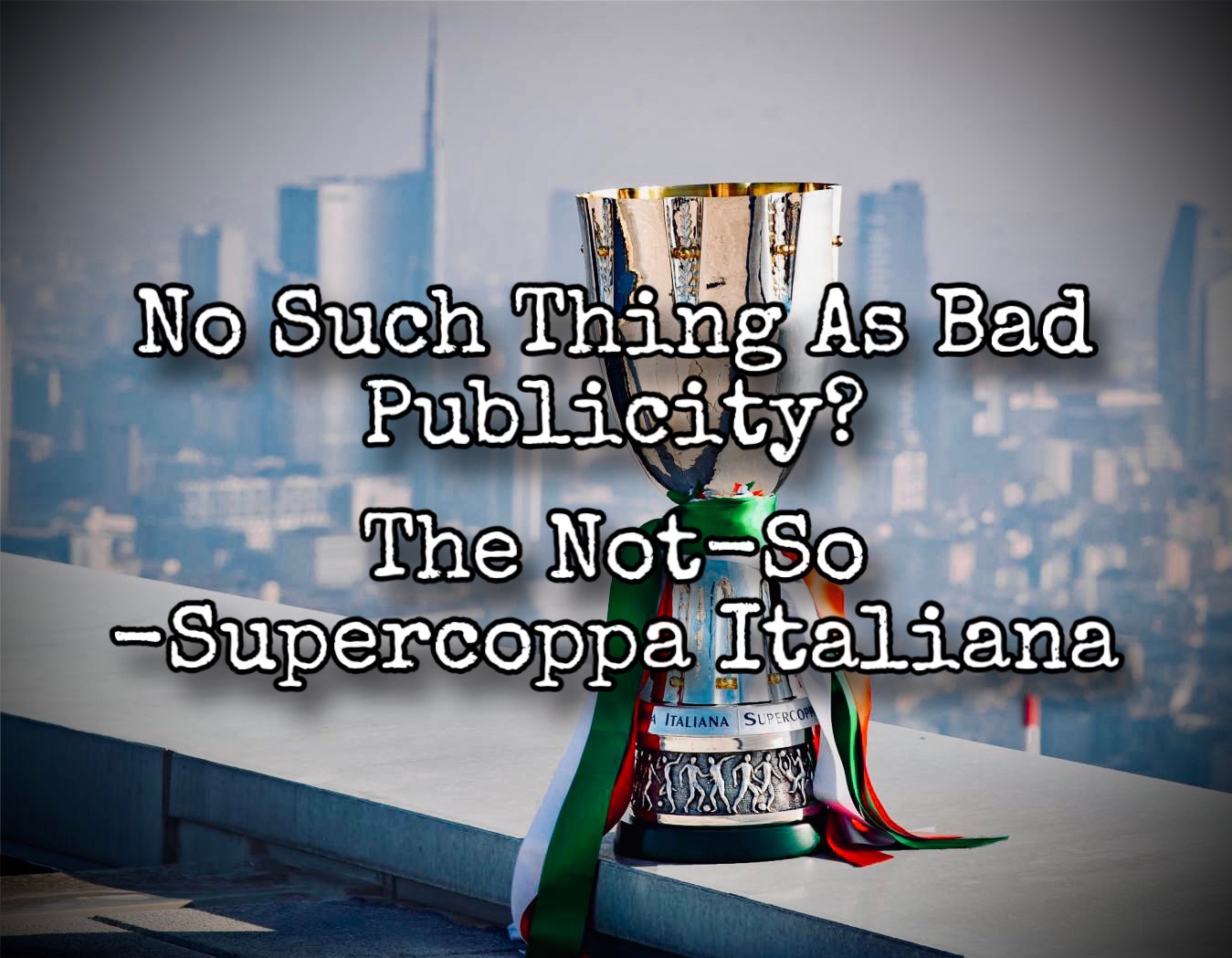
On Thursday evening, Napoli and Fiorentina players lethargically performed before a few thousand impassive customers, in a soulless stadium thousands of miles from home. It was a sorry spectacle as the once magnificent institution of Italian football contorted itself at the whim of the highest bidder.
The official attendance of Napoli v Fiorentina was 9,782, though the images shown on television suggest this is an optimistic assessment. “Don’t worry”, they said, it’ll be full for Inter v Lazio. Yet only 20,767 attended that fixture the following evening.
It’s easy to pour scorn on the decision to stage these matches on another continent, particularly in a country which has been widely castigated for its track record on equality and human rights. Similarly, we can criticise the unnecessarily expanded four-team format scheduled in the middle of the domestic season. And you should do all of the above.
But recognise that the vexed history of the Supercopaa Italiana runs deeper than all of that.
Embed from Getty ImagesThe concept for the competition was cooked up by a group of Sampdoria tifosi following their 1988 Coppa Italia victory. The one-off match, played between the reigning Italian champions and the Coppa Italia holders, was modelled on the English Charity Shield.
The competition endured an inauspicious start when having gained the blessing of the Italian Football Federation, it kicked off a year late, in June 1989, to avoid a clash with the Seoul Olympics. Milan defeated Sampdoria in the inaugural match at San Siro, though the attendance of 19,412 suggests that the showpiece match had not immediately captured the imagination of the Italian public.
To get back on track, the 1989 Supercoppa was staged just five months later. Once again, Sampdoria fell to defeat at San Siro, this time to Inter, in front of a mildly embarrassing attendance of just 7,221. The competition could have died a dignified death at this point, but they forged on.
There was a persistent air of public apathy towards these games, the only exception being when a Maradona-inspired Napoli crushed Juventus 5-1 in front of 62,404 spectators at Stadio San Paolo in 1990. Thinking outside of the box, the Federation decided to take the show on the road as they sought to build the appeal of Italian football amongst a global audience.
Milan and Torino packed their bags and headed to Washington, USA for the 1993 match. However, it was not an unmitigated success. Whether it was the choice of venue or perhaps a reflection of the Americans’ nascent relationship with soccer, just 25,268 turned up at the Robert F Kennedy Memorial Stadium – a venue that could have accommodated almost double should the demand have been there.
The fundamental problem of lifting and dropping the spectacle of Italian football onto another continent is that it is missing a key ingredient. It is the colour, cacophony and chaotic energy of the curva that makes Italian football unique in European football. Twenty-two players kicking a ball around a foreign field is always likely to be an underwhelming rendition of the authentic spectacle.
Embed from Getty ImagesFor the next eight editions, the match would return to Italian shores, but public indifference persisted. A low point came in January 1996, when just 5,289 attended a fog-bound Stadio Delle Alpi for Juventus v Parma. Neither the promise of Vialli and Del Piero – European Champions in waiting – nor the prospect of Ballon d’Or winner Hristo Stoichkov could entice people to the stadium.
In 2001, the Federation decided to repeat the experiment of hosting the game abroad – first in Tripoli, Libya and then at the Giants Stadium in New Jersey, USA. The first of these was a bizarre affair facilitated by the cordial relations between the Berlusconi administration and the Gaddafi regime. The game was played on a sand-based pitch in front of 40,000 spectators – a figure achieved because ticket prices were slashed by two-thirds in the final hours before kick-off. The Federation were said to have pocketed €1.5 million for their troubles.
As the games alternated between home and abroad, the forays into China between 2009 and 2012 proved relatively successful with well-attended matches at the Olympic Bird’s Nest Stadium in Beijing. The decision to host the 2014 and 2016 matches in Qatar’s bijou Jassam Bin Hamad Stadium (capacity 15,000) was the clearest indication yet of a shift in strategy that prioritised a sizeable dowry and long-term financial relationships over the quick buck earned at the turnstile.
The Supercoppa was first hosted in Saudi Arabia in 2018 amidst howls of protest against the country’s dubious human rights record. This came to a head when it was announced that women would be forbidden from buying tickets in most areas of the stadium, limited to designated “family” sections only. However, money talks. The Italian Federation received €7.5 million from the Saudi state; double what they had received from China.
Embed from Getty ImagesThis year (2024) marks the beginning of a new six-year agreement to stage the matches in Saudi Arabia. Each edition will be worth €23 million to the Federation but, in return, their hosts have demanded an expanded four-team format. €8 million of the bounty will be offered up to participating teams as a prize fund. To put this in context, prize money for the top three in Serie A (2022/23) was €23.4m, €19.4m and €16.8m, respectively. So, not bad for a few days’ work.
Only the Italian Federation can judge whether their Supercoppa strategy is bearing fruit in expanding its global reach. After two years of staging the Supercoppa in Saudi Arabia, Serie A resorted to showing matches to Middle Eastern viewers via their own YouTube channel after failing to receive any satisfactory offers for the regional broadcast rights. That has since been remedied with a deal worth €75 million over the next three seasons. However, if the overall objective is to make up ground with other European leagues, the benchmark is the €650 million three-year deal which the Premier League is currently negotiating.
For all of the moral and logistic problems of staging the Supercoppa on a different continent – and there are a great many – the inherent problem is arguably the Supercoppa itself. Forlorn and unloved, the humane thing would be to draw a line under the sorry competition.
It is clear that the lethargic public attitude towards the Supercoppa was a strong push factor initially in taking the matches abroad – but it is the sizeable bounties now being offered by foreign states that will ensure it continues to limp on. In doing so, the Italian Federation is testing to destruction the old adage that there’s no such thing as bad publicity.


 Calcio England