
There was once a time when the rest of the footballing world looked up to Great Britain with great reverence.
As pioneers of the beautiful game, Britain enjoyed an elevated status amongst their peers throughout the first part of the 20th century. Clubs were invited to all corners of the globe as sporting missionaries, to exhibit their tactical and technical prowess.
Against this backdrop, Burnley travelled to Italy on an all-expenses paid ticket in the summer of 1922.
The tour presented a rare opportunity for Burnley’s players and officials to sample another culture, whilst their hosts believed that The Clarets’ visit would create a lasting legacy for the Italian game.
On the pitch, Burnley encountered a nascent footballing scene, rudimentary facilities, baying crowds and hapless referees. On the streets, they witnessed the rising tide of fascism in Italy.

(Source: The Unofficial Liverpool Football Club Museum)
Burnley’s travelling party left Bank Top station on 17th May. Their cheery mood was tempered only by the foreboding prospect of a two-day journey over land and sea, taking in London, Dover, Paris, Lyon, Turin and finally, Milan. They would be joined in Italy by rivals Liverpool, the newly crowned champions of England, who had finished 8 points ahead of The Clarets in the First Division.
The two English clubs would contest an exhibition match in Milan, before embarking upon separate itineraries for the remainder of the tour.
But, first, they would be treated to a luxurious stay in the Italian Lakes. The players were captivated by the beauty of the crystal blue waters, snow-capped peaks and infinite starry skies. Writing home, Liverpool and England full back Ephraim Longworth declared, “it is impossible to describe such a place with a pen”.
The players enjoyed a boat trip on Lake Maggiore and bathed in the waters to provide relief from the stifling continental heat. An exotic evening was spent at the casino. Just one regret was expressed; that of Burnley full-back Len Smelt, who wished he had brought his fishing rods with him. When the time came to depart for Milan, they were understandably reluctant to leave.

(Source: The Unofficial Liverpool Football Club Museum)
The exhibition clash between the two clubs was hosted at AC Milan’s home ground, Stadio Viale Lombardia, on the east side of the city. The winners would be awarded gold medals and a plum itinerary taking in Venice and Bologna. Meanwhile, the runners-up would make their way to Tuscany.
Liverpool took to the field in their traditional red shirts, Burnley in a yellow and black change kit. In searing temperatures, many of the players donned neckerchiefs to absorb their perspiration and buckets of water were placed around the perimeter of the pitch to provide some respite. At the end of the three-week tour, one Burnley player claimed to have lost a stone in weight from playing in such oppressive conditions.
The humidity took its toll on the pace of the game, much to the displeasure of the expectant 10,000 crowd. A solitary goal from Scottish defender David Taylor was enough to take victory for The Clarets.
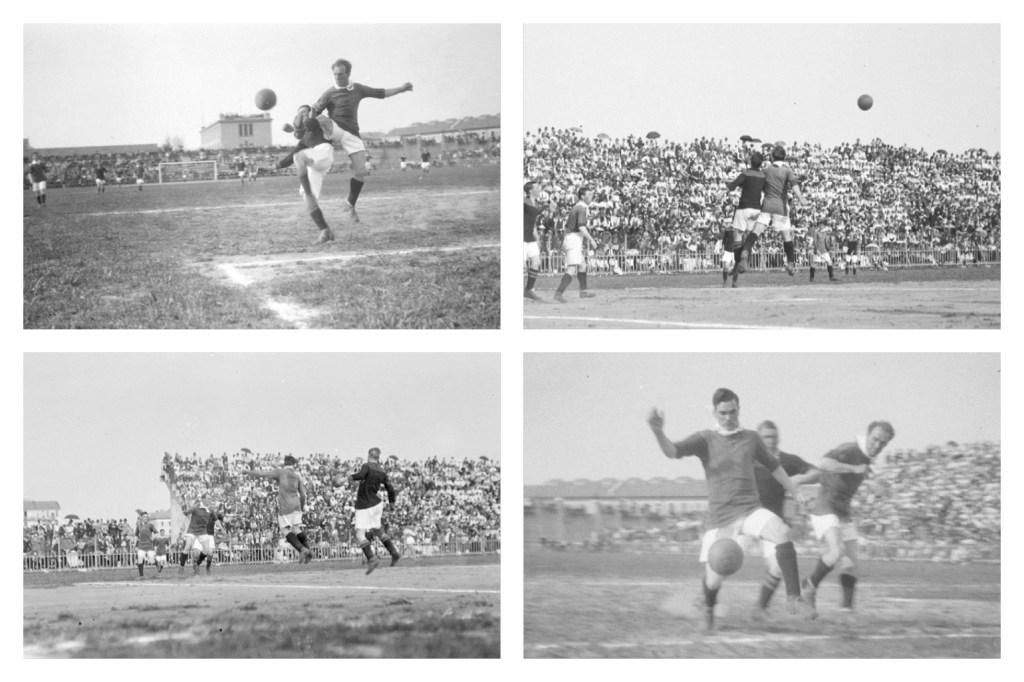
(Source: The Unofficial Liverpool Football Club Museum)
The next stop on Burnley’s tour, three days later, was Turin and a fixture against a Piedmont representative team featuring players from Juventus, Torino and Alessandria. The local newspaper offered a less than complimentary verdict on Burnley’s performance as they fell to defeat, concluding that the touring team had appeared “disinterested”.
Onwards, The Clarets traversed the breadth of Italy for a much-anticipated visit to Venice. The highlights of that trip – as reported in the Burnley Express – were a visit to a glass-blowing factory and the novel spectacle of a waterborne Venetian funeral procession. Despite Venice’s beguiling beauty, the prevailing sensation had been the repugnant stench of the canals in high summer. As Burnley headed inland for their next fixture, it seemed Venice had not lived up to expectations.
The Clarets faced a Veneto representative team, comprising players from Padova, Verona and Udinese. Burnley had been surprised by the primitive nature of the playing facilities they encountered in Italy; uneven surfaces made of compacted mud, which were considerably smaller than the pitches back home. Padova’s home stadium (still there today, but now known as Velodromo Monti) was no exception.
The guest of honour for the fixture was Prince Amedeo, a member of Italian royalty and hero of the First World War. Burnley endured a difficult start when forward James Lindsay fell awkwardly, dislocating his elbow. In the pre-substitute era, he was attended to by a doctor before intrepidly returning to the fray. The local journalists reflected on Burnley’s “precise and powerful” game as they rode out 3-1 winners.

Next, Burnley headed south to Bologna for a match against an Italian Select XI.
However, upon arrival, it soon became apparent that all was not well. The city was under siege. Fascist mobs had already taken over the neighbouring cities of Ferrara and Modena. In Bologna, thousands of fascists – armed with clubs, bludgeons and firearms – were on the rampage. The aggressors had already set fire to Communist meeting places and the Labour Exchange and were now surrounding the Government Palace, attempting to overthrow the city’s Prefect.
Burnley had caught a glimpse of this brewing civil unrest earlier in the trip when a member of the Liverpool party, with a red handkerchief in his top pocket, was attacked in the street. He had been mistaken for a Communist. Nonetheless, Burnley were astonished by the extent of the disorder in Bologna. They were informed by their hosts that it was a labour dispute and, too polite to probe any further, only fully grasped the gravity of what was happening after they had returned home.
Despite this political turmoil, the Italian FA had been keen for the match to go ahead in Bologna, but the police refused. Instead, Burnley packed their bags and returned to Milan to face a hastily assembled Italian representative team. The game was nothing short of a farce. A purring Burnley outclassed their opponents in another 3-1 victory, with the local newspaper eulogising their “pretty movements that bewildered their opponents”.
The Italian crowds encountered on the tour had been far more strident than those back home in England. The hordes demanded goals and entertainment and, as Burnley took their foot off the gas, the crowd howled at what they perceived as unadventurous play.
The referee was also the target of their wrath. Having harshly ruled out two Burnley goals, he had to be locked in the changing rooms after the game until the angry crowds dispersed. More generally, the standard of Italian refereeing on the tour had been abysmal. For example, Burnley were mystified to find that referees tended to confine themselves to just one side of the pitch. The diplomatic verdict was that Italy was “badly in need of someone to teach them the finer points of the game”.
The game had also been punctuated by a bizarre turn of events during the interval. The referee left the ball on the pitch at half-time…from where it was seized by a member of the crowd. When the players returned, the ball, having been kicked around on the terrace, was not in a condition to be used. As officials searched for the spare match ball, Burnley’s reserve goalkeeper Jerry Dawson sheepishly confessed that he had deflated it and put it in his bag as a souvenir. By the time it had been retrieved and re-inflated, a full thirty minutes had passed.
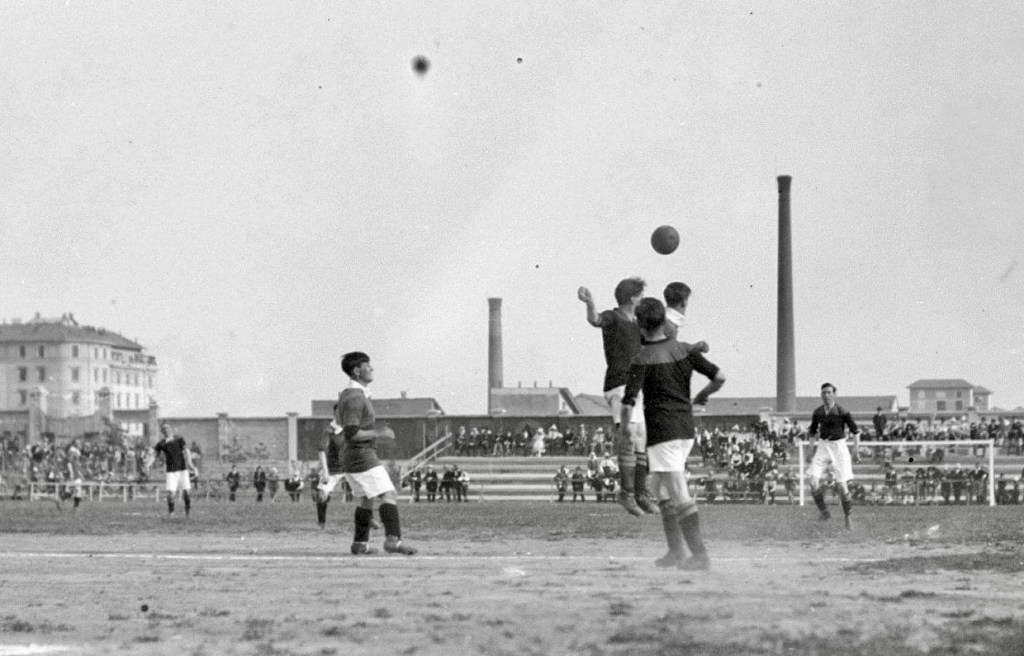
(Source: The Unofficial Liverpool Football Club Museum)
The following day, Burnley headed west to play Novara in the fifth and final match of the tour. It was a bad-tempered affair where neither team covered themselves in glory. Any semblance of quality went out of the window as players nervously peered over their shoulders in anticipation of the next agricultural tackle.
The situation boiled over when Burnley’s George Richardson, lying prone on the floor, was kicked by an opponent. When he retaliated, all hell broke loose. Rabid supporters clambered over the fences to confront Richardson, one attacking him with a pole. The intervention of the police was required to restore order.
Thankfully, a violent afternoon of football was soon forgotten when the players from both teams convened for a more amicable evening meal and sing-song.
Burnley’s final duty was to head to Turin, where they would join up with Liverpool for a celebratory dinner hosted by the Italian FA. That marked the close of an unforgettable and at times perplexing tour, played out against a toxic political backdrop. Just a few weeks later Mussolini’s Blackshirts would march on Rome.
Thanks for reading! This article was pieced together with research in the British Newspaper Archive and the La Stampa Archive. If you enjoyed this, check out our piece on Tom Finney’s transfer to Palermo.

 Calcio England