
As the Arno River winds westward from Florence to the Mediterranean, it flows through the unassuming town of Pontedera. Better known for its mopeds and Chianti than for calcio, this quiet Tuscan enclave would, for one extraordinary afternoon in April 1994, instigate Italian football’s greatest humiliation.
Italy’s 1994 World Cup Preparations
With the World Cup just months away, national team coach Arrigo Sacchi convened an Easter training camp at the Coverciano training centre. Defeats to France and Germany had left the self-styled Prophet of Fusignano under pressure. This camp offered another chance to assess his squad – and restore some confidence.
Eighteen players were called up, much to the chagrin of their club coaches. Only those from Parma and Sampdoria, committed to midweek fixtures, were excused. For all intents and purposes, this was Sacchi’s A-team.
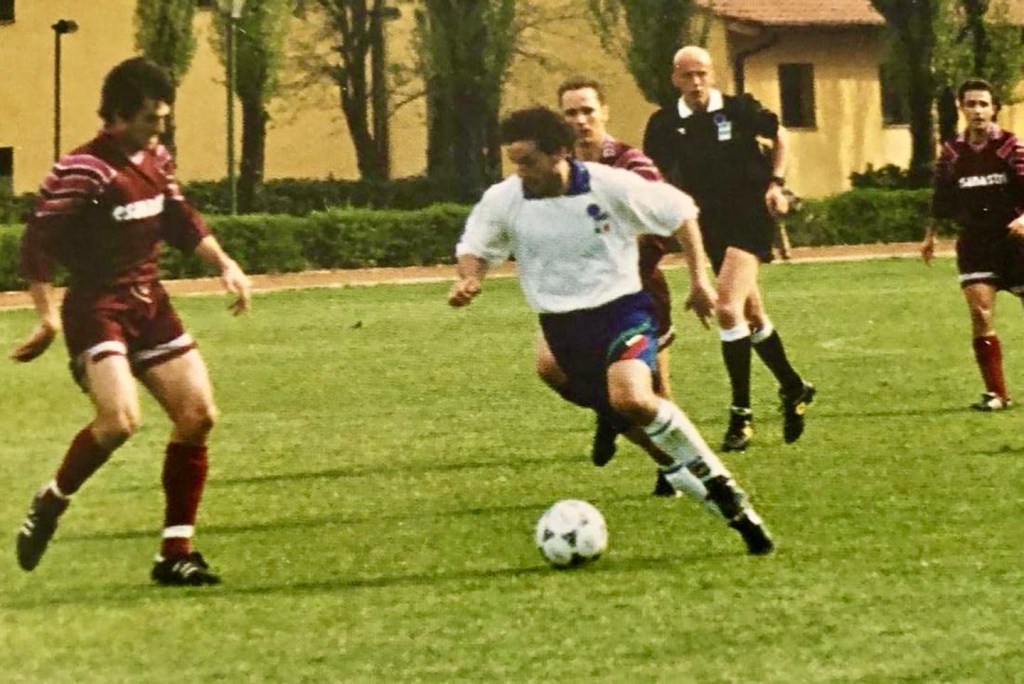
The Match That Shook Gli Azzurri
Sacchi sought an opponent for a training match on the final day of the camp. The invitation went to Pontedera, a fourth-tier side, an honour almost unimaginable for such a modest club. Their record was unremarkable: they had never risen above the third tier, and their most notable alumnus was a young Marcello Lippi, who began his coaching career there in 1986.
But in 1994, Pontedera were flying. Undefeated and top of Serie C2, they were brimming with belief. Coach Francesco D’Arrigo recalled, “Sacchi asked me to play like Norway, Italy’s upcoming World Cup opponents: pressing high, doubling up, suffocating the ball.”
The Italian lineup that day was glittering. The back four came straight from Milan: Baresi, Costacurta, Maldini and Panucci. Albertini and Conte held the midfield, flanked by Donadoni and Stroppa. Up front, the diminutive pairing of Roberto Baggio and Beppe Signori led the line. And overseeing it all? A young local referee named Pierluigi Collina.
Italy started slowly, perhaps fatigued by that morning’s training session. But what followed shocked everyone.
Midway through the first half, Pontedera’s Matteo Rossi slipped past Paolo Maldini and coolly chipped over Luca Marchegiani. 1–0. Moments later, a corner led to a scramble in the box; Marchegiani parried the initial effort, but Alfredo Aglietti pounced to double the lead.
2–0 at half time. Italy hadn’t mustered a single shot on target.
Sacchi’s Desperate Measures
Sacchi responded by abandoning the Baggio–Signori experiment. On came Daniele Massaro and Pierluigi Casiraghi to add bite to the frontline. Meanwhile, in a surreal twist, the designated linesmen were replaced by Sacchi’s own staff: Carlo Ancelotti and Pietro Carmignani.
The second half brought marginal improvement. Massaro pulled one back, but Italy still looked flat. As full-time approached, Sacchi – desperate to avoid humiliation – signalled to Collina to continue the game. Five minutes passed. Then six. Seven. Eventually ten. Yet the equaliser never came. Nothing could save Italy now.
Aftermath of a Shock Defeat
When Collina finally ended the match, Sacchi was left to face the fallout.
To his credit, Sacchi privately congratulated Pontedera. But in front of the cameras, he downplayed the defeat. “This is the most difficult moment since I’ve been here,” he admitted. “But the alarm bells were ringing – even before this.”
The media, of course, had a field day. La Gazzetta dello Sport led with the now-legendary headline: “Ai Mondiali Il Pontedera”—“Pontedera to the World Cup.” A fourth-tier side had just beaten Italy’s finest. Not in a dream. Not in a comic strip. But on the sacred turf at Coverciano.
Pontedera’s Modern Tribute to a Historic Victory
Though the match never entered official records, its legend endures. And this season, thirty years on, Pontedera found a new way to commemorate it.
For 2024/25, the club’s home shirt, manufactured by Errea, featured a sublimated image of that iconic Gazzetta front page. A tribute not just to an incredible upset, but to the day a small town stopped the giants of Italian football in their tracks.


 Calcio England