Italia ’90 opened with a scene of breathtaking drama – unlike anything the World Cup had delivered before.
The soaring San Siro provided the stage. An architectural wonder audaciously extended skywards. The luscious green turf bathed in early evening sunshine. An arena awash with colour and an aura of anticipation.
That undeniable splendor was in stark contrast to the brutal action that next unfolded. A terrifying Cameroon team fought, kicked and bullied reigning World Champions Argentina into submission. It was an upset for the ages. Braun prevailing over beauty.
But this was not the first act of Italia 90.
It had all begun some eight years earlier. Long before a ball had been kicked on Italian soil, there was a tale laced with intrigue and controversy. A story in its own right. We’ve taken our research to the next level to uncover the long-forgotten prelude to the Magic Nights.
The Beginning
In 1982, a posse of nations assembled to contest the right to host the 1990 World Cup. Reigning World Champions Italy, England, the Soviet Union and Greece all declared an interest in becoming host nation. It was perhaps an early indication of the Greek’s withering commitment to the process that they posted their application to FIFA HQ in Zurich whilst the other nations sent delegates to hand-deliver their bid documents.
Two years on, in March 1984, and four became two. England withdrew their bid whilst Greece failed to submit the documentation required to keep them in the competition. A vote of FIFA Committee Members two months later saw the tournament awarded to Italy. It was suggested that the Soviet Union’s imminent boycott of the 1984 Los Angeles Olympics had swayed committee members, although this was strenuously denied by then FIFA President Joao Havelange.
Host Cities
The real work was about to begin. The Italian organising committee had important early decisions to take regarding host cities. Naturally, domestic politics played a role, and a diplomatic allocation was devised that ensured the whole peninsula stood to gain from the tournament and its legacy.
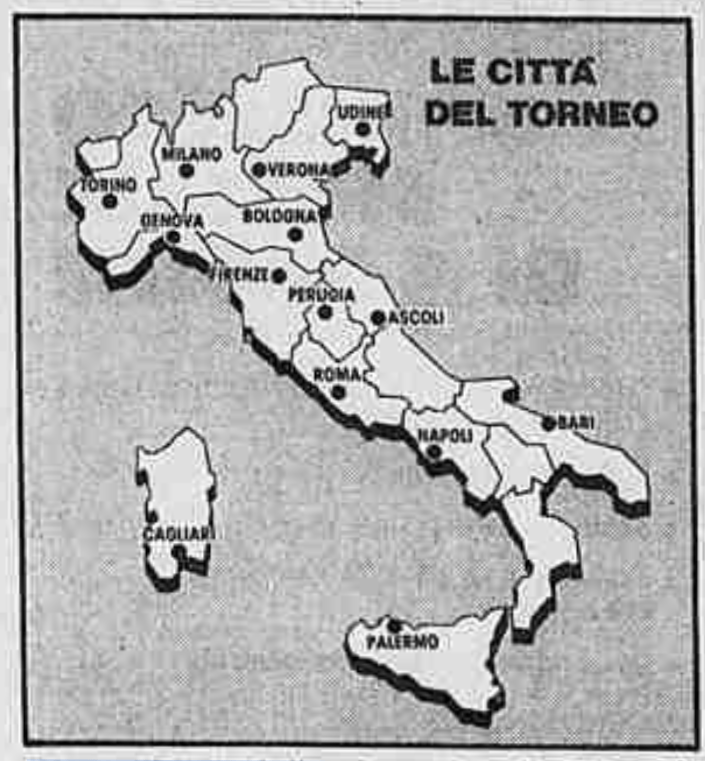
Fourteen cities were included in Italy’s bid documents, spanning north, south, east and west, including the islands of Sicily and Sardinia. With twelve cities ultimately hosting matches – Rome, Milan, Turin, Genoa, Florence, Udine, Bologna, Verona, Naples, Bari, Cagliari, and Palermo – two unlucky cities had to miss out.
La Stampa newspaper indicated that Ascoli’s Stadio del Duca and Perugia’s Stadio Renato Curi were the backup options that were never required. As a small consolation, Italy did host their pre-tournament friendly with Greece in Perugia.
Qualification
There was no shortage of theatre during the qualifiers.
In North America, Costa Rica’s path to the finals was eased by the disqualification of the previous host nation. Mexico had knowingly fielded at least four over-age players in the 1988 CONCACAF Under-20 tournament. When the deception was discovered, the Mexicans were disqualified and subsequently banned from all FIFA competitions for two years. This gave Costa Rica a bye into the final qualifying round, where they topped the Group to reach the World Cup Finals for the first time in their history.
In South America, Chile had to overcome Brazil in the final qualifier to secure their passage. Amidst a white-hot atmosphere at the Maracana, Careca sent Brazil into the lead. Shortly afterwards, Chile goalkeeper Roberto Rojas crumpled to the turf in a pool of crimson, seemingly struck by a firecracker thrown from the stands. As Rojas was taken away on a stretcher, Chile walked off in protest. However, it later transpired that Rojas had inflicted the injury upon himself using a razor blade concealed in his glove. When the fraud came to light, Brazil were awarded a 2-0 victory. Chile were barred from the 1994 World Cup and Rojas was banned from football indefinitely.
Chile’s faux bloodshed pales into insignificance compared to the violence in the African section. Algeria were eliminated after failing to defeat Egypt in a crucial qualifier in Cairo. In the aftermath, there was a gruesome confrontation between Egyptian supporters and the Algerian team, which resulted in one Egyptian fan losing sight in one eye. He was hit by a broken bottle allegedly flung by Algeria’s star player Lakhdar Belloumi. An international arrest warrant hung over the head of Belloumi for almost 20 years despite testimony from several Algeria players that the missile came from the hand of goalkeeper Kamel Kadri.
Curiously, Israel attempted to qualify for the 1990 World Cup from the Oceana Group. Having previously been part of the Asian Federation, Israel were expelled after a farcical 1978 qualification campaign where North Korea refused to play against them. The 1982 qualifiers saw Israel appear as guests in the European section, whilst for the 1986 and 1990 World Cups they tried their luck in Oceana. Israel topped the final Group ahead of Australia and New Zealand but lost a two-legged play-off to Carlos Valderrama’s Colombia.
The Mascot
“Ciao” was a pioneering World Cup mascot. He broke the mould of a genre previously dominated by ruddy-cheeked boys, animals and anthropomorphic fruit. Ciao was a serious, dynamic figure, constructed from building blocks in the colours of the Italian tricolore.
The design came about in 1986 when the organising committee invited submissions. The work of graphic designer Lucio Boscardin stood out from over 50,000 entries received. Once selected, it was another three years before his design was given a name.
In March 1989, a vote was included on the Italian football pools slip to garner the views of the public. Five options were proposed; Amico, Beniamino, Bimbo, Ciao and Dribbly. After eleven weeks, an estimated 30 million votes were cast and counted before “Ciao” was finally christened.
The Works
The profligacy of Italia ‘90 has been well-documented. Initial spending forecasts were eclipsed as the final bill ran to almost €4 billion. As recently as 2014, Italian Treasury documents revealed that €50-60 million was being paid out every year on the public debt stemming from the World Cup.
Our previous article looked at the white elephants of Italia ‘90, covering Turin’s doomed Stadio delle Alpi and the unfinished hotels and abandoned metro stations in Milan and Rome. As the tournament beckoned, there were genuine fears that the stadia in Milan, Florence and Naples would not be finished in time. By the time the first ball was kicked, only 95 of the 233 planned infrastructure projects had been finished. Many were completed later, but some were never completed at all.
The cost was not just financial. Throughout the course of the construction works, 24 people lost their lives and a further 700 were injured. On 20th April, the Daily Mirror ran a back page headline, “The Terrible Cost of World Cup ‘90”. Italian trades union argued that the burgeoning casualty count was the direct consequence of poor planning and resultant haste. The most high-profile tragedy occurred in Palermo where the collapse of a new roof at Stadio Renzo Barbera caused the deaths of five workers.
The Draw
Italia ‘90 was the first time that the World Cup draw had been turned into a spectacle in its own right. A gala evening was planned, featuring dignitaries, celebrities and a full symphony orchestra. There was a series of short films – one dedicated to each host city – shot by renowned and Palme d’Or-winning film directors.
On the 9th December 1989, FIFA staged a rehearsal draw for Italia ‘90. Sepp Blatter was present in Rome for the dry run, but actors were employed to play the eventual parts of Sophia Loren and Luciano Pavorotti in making the draw. Most remarkably of all, the outcome of the draw was publicised in the media. How might this alternative draw have changed the eventual outcome?
Group 1: Italy, Costa Rica, Colombia, Holland
Group 2: Argentina, USSR, Republic of Ireland, South Korea
Group 3: Brazil, Austria, Sweden, Cameroon
Group 4: Germany, UAE, Uruguay, Scotland
Group 5: Belgium, Yugoslavia, Czechoslovakia, Egypt
Group 6: England, Romania, Spain, USA
The Kit
Cameroon had been expected to wear the same Adidas template shirt as Czechoslovakia and the Soviet Union at the tournament. It was an optimistic design typical of the era, featuring a geometric design over the shoulders and chest. Cameroon had worn a Puma-branded strip during the qualifiers but had struck a new agreement with Adidas ahead of the tournament. This Cameroon Adidas shirt even featured in a photo shoot of the Italian squad, where each player donned the shirt of a participating nation. Gianluca Vialli represented Cameroon in the fabled shirt. However, when it came to the kick-off, supply problems caused a change of plan. Cameroon turned out in an altogether more mundane shirt with a sublimated stripe, a design shared with Egypt.
Less Than Ideal Preparation
Cameroon had qualified for the World Cup with Soviet coach Valery Nepomnyashchy at the helm. Although his leadership had delivered qualification, his unusual methods were beginning to wear thin on the eve of the tournament. Their pre-tournament camp in Yugoslavia was characterised by 7 am training sessions, rudimentary accommodation and enforced silence on team coach journeys. This culminated in a humbling defeat to a Yugoslav youth team in their final warm-up game. Long before Cameroon landed in Italy, there were rumblings of discontent within the camp.
Even at an administrative level, they couldn’t get things right. Having missed the deadline for submitting their squad details in late May, Cameroon were missing from the official lists announced by FIFA and received a fine for their oversight.
Happily, the Cameroon Association kept faith with Nepomnyashchy. But several coaches were not afforded the same opportunity to finish the job they had started.
Player power saw the removal of Thijs Libregts from the Netherlands hot seat after leading the Dutch to the finals. He was replaced by Leo Beenhakker. Under similar circumstances, Marvin Rodriguez steered Costa Rica to qualification but was harshly axed in favour of Bora Milutinovic ahead of the tournament. Belgium’s Walter Meeuws secured qualification but abdicated when a match-fixing scandal undermined his position. His predecessor, Guy Thys, re-took the reins in Italy.
However, no country demonstrated the apparent indecision of the United Arab Emirates. The UAE had only been a country for two decades when they were led to qualification by legendary Brazilian coach Mario Zagallo. The Professor was a three-time World Cup winner; twice as a player in 1958 and 1962 and again as a coach in 1970.
He had skillfully guided the UAE, a state of fewer than 2 million citizens, to Italia ‘90 by clinching the second spot in the Asian qualifiers in October 1989. He duly rewarded himself with a 6-week holiday in Brazil. This proved the tipping point in an ongoing rift between Zagallo and the Football Association, leading him to be replaced by Polish coach Bernard Blaut.
However, the UAE’s dismal performance in the Gulf Cup in springtime (3 draws, 2 defeats) saw Blaut relieved of his duties after 53 days at the helm. Just weeks ahead of the World Cup, they turned to another Brazilian in Carlos Alberto Parreira. Parreira had previously coached the UAE and duly led the team in Italy.
The Warm-Up
Milutinovic’s Costa Rica were one of the first teams to arrive in Italy. Having been expected to touch down on 28th May, the organising committee were taken by surprise when the squad appeared in Rome almost 3 weeks early. Hasty arrangements were made to accommodate the Costa Ricans, including a friendly against a rapidly assembled Lazio team (which the hosts won 2-1).
Oscar Tabarez’s Uruguay pitched up in northern Italy at the beginning of May and embarked upon a far-reaching schedule of provincial fixtures. Their calendar included appointments against Brescia, Padova, Mantova and Chievo, along with contests against amateur Italian clubs Ospitaletta, Majanese and Pro Fagagna.
The weeks leading up to the tournament provided some wonderfully far-fetched combinations and mouth-watering scorelines. Those heady weeks gave us Italy 3-0 Cannes (featuring a 17-year-old Zinedine Zidane), Inter 2-2 Costa Rica, Triestina 1-5 Spain, United Arab Emirates 3-1 Imola, USS Casalecchio 1-5 Colombia and Umbria XI 1-0 Brazil.
England got in on the act too, beating Cagliari 6-0, then following it up with a 10-2 victory over a Sardinia XI. The latter fixture was played at a provincial stadium against a team comprised of amateur players – with one exception. Gianfranco Zola, fresh from a Scudetto success with Napoli but not in the Italian squad came to play in the exhibition match. In the first minute of the match, before the Sardinians had even touched the ball, Steve McMahon put through his own goal. It was an intentional gesture in front of England’s travelling supporters, intended to symbolise the futility of hooliganism ahead of the tournament proper.
The Eve of The Tournament
The redevelopment of Stadio San Siro for the tournament was a visionary architectural venture. The works retained the aura of the historic venue yet simultaneously transformed it into a futuristic basilica of sport. For all of its undeniable aesthetic appeal, there were however some more practical issues. The long shadows cast by the towering third tier and the lack of airflow inside the arena meant that the grass was wilting.
The pressure was on to get things right for the curtain raiser on 8th June. Drastic measures were required. At the end of April, AC Milan were forced to play their last league match against Bari in Bergamo to allow the newly re-laid pitch to bed in. When West Germany and Argentina arrived in Milan they were denied the opportunity to train on the pitch as the organising committee took no chances on the state of the playing surface. The pitch held up for the duration of the tournament, but as we now know these issues continued to dog the stadium in the years ahead.
Thunder in Paradise
With heightened expectations for a tournament played on home soil, Italy used the Coverciano Technical Centre in Florence as their pre-tournament base. However, their preparations were disrupted by one of the most controversial transfers of the decade. Roberto Baggio had just agreed to join Juventus from Fiorentina for £7.7million.
Thousands of disgruntled Fiorentina tifosi descended on the training centre, hurling insults and missiles at their former hero. Two hundred riot police were called in from Florence, Roma and Bologna to deal with the disorder. With some semblance of calm restored, Baggio sheepishly offered an olive branch, indicating that he would dedicate his first goal at the tournament to his former disciples.
Those troubles were nothing compared to the dark political clouds gathering over Yugoslavia. On 13th May 1990, a riot broke out in the highly-charged match between Dinamo Zagreb and Red Star Belgrade. This powder keg fixture was a microcosm of the brewing conflict between Croat and Serbian factions.
When a Yugoslav police officer assaulted a Dinamo supporter, 21-year-old midfielder Zvonimir Boban felt compelled to act. He famously launched a kick at the police officer. In that very moment, Boban became an icon of Croatian resistance.
Having made his full international bow in 1988, Boban was forming a compelling case for inclusion in the World Cup squad. However, those hopes were erased when the Yugoslav Football Association imposed a nine-month ban on Boban for his actions. With Yugoslavia barred from Euro 1992 and the newly formed entity of Croatia not participating in World Cup 1994 qualification, it would be six years before Boban finally got to perform at an international tournament, wearing the captain’s armband for Croatia at Euro 96.
Thanks for reading! If you enjoyed this, check out our article on the white elephants of Italia ’90.


 Calcio England