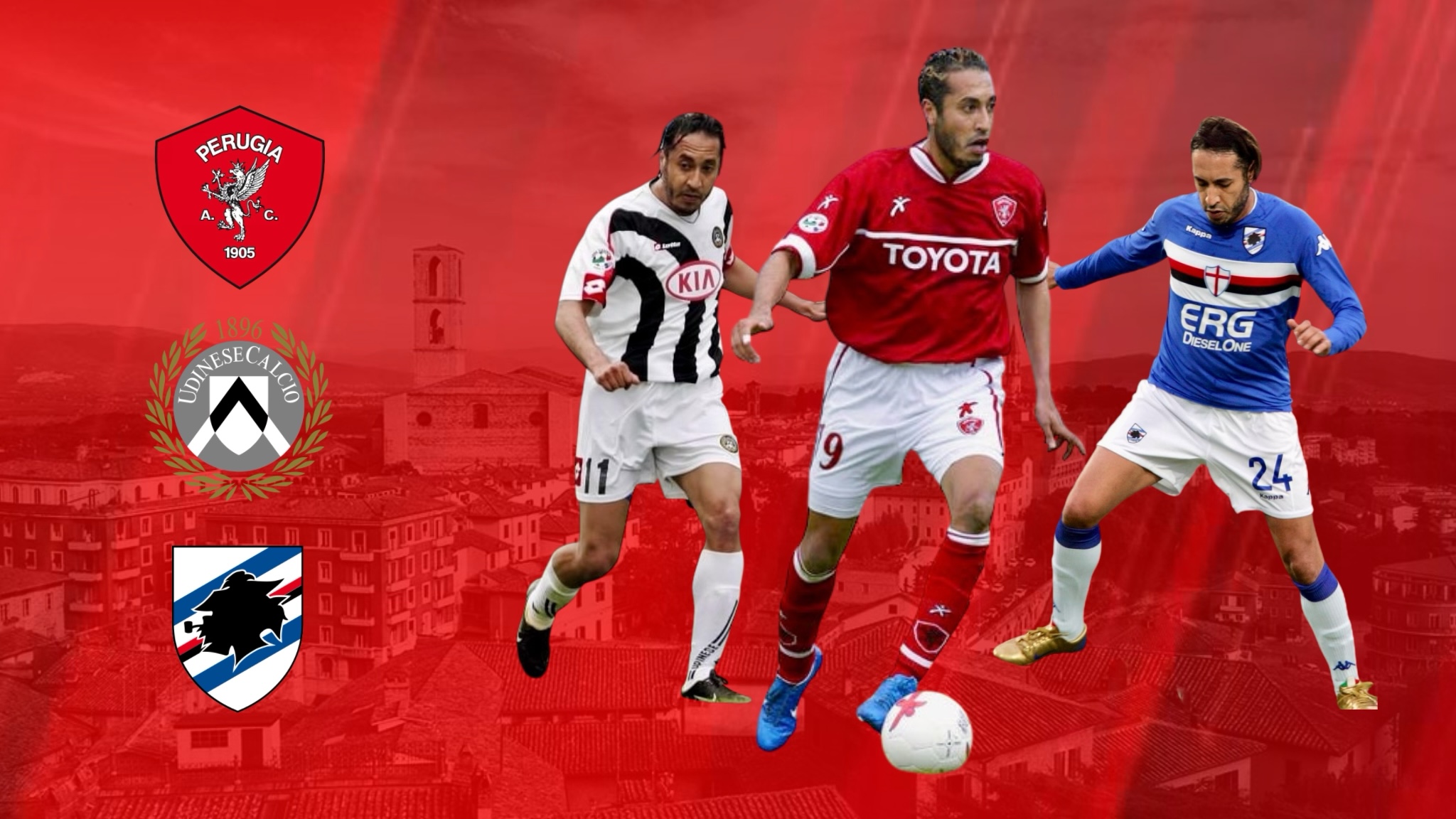
Tucked away in Perugia’s Stadio Renato Curi is a modest museum. Scarves, balls, faded photographs and shirts trace the history of a proud provincial club. In one glass cabinet sits a single silver boot. At first glance, you’d assume it belonged to a player of note — Hidetoshi Nakata perhaps, or some hero of a famous victory.
But no. The boot belonged to Al-Saadi Gaddafi, son of Libya’s dictator Muammar, and perhaps the most farcical figure ever to appear in Serie A.
His story is not one of footballing merit but of politics, petrodollars and vanity. It is a tale of a privileged playboy indulged by Italian football’s weakest instincts – a cautionary reminder of how far prestige can be sold when money and power come knocking.

From Colonel’s Son to “Captain”
Gaddafi’s third son had little interest in inheriting his father’s iron grip on Libya. Saadi preferred nightclubs and narcotics to politics. A leaked US diplomatic cable depicted him as a hard-drinking, trouble-prone black sheep.
By 2000, either out of boredom or paternal pressure to find greater purpose, Saadi chose an unlikely career pivot: professional footballer. He was 27, but trivialities like age or talent pose no obstacle when you are the son of a dictator.
Saadi bought Al-Ahly Tripoli, installed himself as chairman, captain and penalty taker. He recruited Diego Maradona and disgraced sprinter Ben Johnson as his “coaches.” Commentators were forbidden from mentioning any teammate’s name; only shirt numbers, to ensure the spotlight stayed fixed on Gaddafi.
In one match against Al-Nasr Benghazi, the opposition walked off the pitch in protest at a dutiful refereeing performance. Saadi responded by effectively closing that club down.
Saadi’s grip tightened when he took over the more established Al-Ittihad Tripoli club and won two consecutive championships as player-owner. Simultaneously, he became vice-president of the Libyan football association.
Libyan football became theatre: results predetermined, opponents cowed, all serving the whims of the privileged heir.

Oil, Influence and Italy
Domestic dominance wasn’t enough. Encouraged by his own distorted reality, Saadi was hungry for a bigger stage. Italy was the obvious target. Libya had been an Italian colony, and Colonel Gaddafi enjoyed a close friendship with Prime Minister Silvio Berlusconi, lubricated by oil deals and reparations.
The Libyan Arab Investment Fund bought a minority stake in Juventus. The state oil company, Tamoil, plastered its logo across the club’s famous shirts. Saadi even joined Juve’s board of directors and was the driving force in staging the 2002 Italian Super Cup in Tripoli.
His ultimate dream, naturally, was to wear the black-and-white stripes himself. Coach Marcello Lippi killed that fantasy, threatening to resign rather than hand Gaddafi a place in his squad. But not every Italian was so principled.
Luciano Gaucci, the eccentric ringmaster of Perugia, saw opportunity where others saw farce. No stranger to controversy, he had previously attempted to sign a female player for the club and later sacked South Korean forward Ahn Jung-Hwan for having dared to score against Italy at the World Cup.
In June 2003, at a gala evening hosted at Gaucci’s Umbrian castle, 30-year-old Saadi was unveiled as Perugia’s latest recruit. Gaucci used this platform to rebut the persistent accusations of oil-fuelled opportunism. “No money, no sponsors, no business. He’s intelligent, good at dribbling, and has a fine left foot,” he insisted with a straight face. Few believed him.

The Circus in Perugia
Saadi’s arrival transformed quiet Perugia into a surreal stage set. He occupied the top floor of the luxurious Brufani Palace hotel, arrived at training in a yellow Lamborghini, and moved with an entourage of bodyguards, personal secretaries, and even dog handlers. Al Jazeera cameras trailed his every step. “It was like a reality show,” recalled teammate Emanuele Berrettoni.
Saadi worked hard in training, earning the respect of teammates, even if his physical and technical limitations were obvious. Those relationships were also oiled by Saadi’s intoxicating generosity. He treated his teammates to impromptu trips to Hollywood parties and Caribbean retreats. And, later in his tenure, he stumped up the funds to cover the wages when Gaucci’s account was running dry.
Saadi struck up an unlikely friendship with a 21-year-old striker, Jay Bothroyd. The pair would take private jets to go shopping in Milan. When it was Saadi’s birthday, he took Bothroyd and a handful of teammates to Cannes, where the Pussycat Dolls performed privately. Saadi even insisted on paying for Jay Bothroyd’s honeymoon, recalling, “money to him was like fresh air. His entourage carried suitcases of money around”.
This extraordinary lifestyle, the glamour, the generosity, was all in stark contrast to the hardship endured by Libyan nationals under his father’s brutal rule.

The Long Awaited Debut
Saadi’s first appearance in a Perugia shirt went suspiciously well: he came off the bench in a pre-season friendly against amateurs Virtus Bassano and scored twice in a 12–0 rout11. It was a promising start on paper, though there were whispers about the commitment shown by the opposition that afternoon.
Then came the long wait for a competitive debut. Excuses piled up. First, he had to formally step down from his Juventus board role. Then came a string of convenient ailments. The inescapable truth was that Saadi was nowhere near the standard required to compete in Serie A.
When he finally made Perugia’s bench, disaster struck again — a failed routine doping test earned him a three-month ban.
It took ten months after arriving in Italy for Saadi to get his big moment. In May 2004, with Perugia fighting relegation, he was sent on for the final quarter of an hour against none other than Juventus, his boyhood favourites. For fifteen minutes, he shared the pitch with Alessandro Del Piero and company as Perugia clung to a vital 1–0 win.
The press, however, were unimpressed. La Stampa dismissed his contribution as “a statistical fact; an appearance and nothing more.”
Saadi, however, was jubilant. Tradition demanded that a debutant treat his teammates to dinner. Deciding that wasn’t enough, he instead handed every player a brand-new Mercedes A-Class.

The Dream Goes On
Perugia’s and Saadi’s season ended in relegation. Livorno’s colourful president Aldo Spinelli – perhaps enticed by the promise of Libyan wealth – floated the idea of bringing him to Tuscany22. Saadi declined, choosing loyalty to Gaucci and a year in Italy’s second tier.
There, he was little more than a spectator. His contribution amounted to two cameo appearances in the early rounds of the Coppa Italia, while Perugia struggled in vain to return to the top flight.
By summer 2005, the farcical experiment seemed to be coming to an end. Yet, remarkably, Champions League-bound Udinese offered him a contract. It was a baffling decision – paradoxically one that made perfect sense when viewed through the prism of Libyan money and influence.
In Friuli, little changed. The concierge33 of his hotel later published a memoir describing Saadi’s excesses. His dog was pampered like royalty, complete with its own room. His wife, when visiting, was said to bathe in milk. And when she wasn’t around, the routine shifted to hedonistic nights: parties that spilled across suites, with a private jet always on standby for spontaneous trips to has favourite strip club in Paris.
On the pitch, his contribution was negligible: a single substitute appearance in a dead rubber against Cagliari, in which he nearly scored with a looping shot. Post-match, when asked about his future, he offered a telling reply in English – “You’ll have to ask my father.”

The Final Act
The dream seemed to be over for Saadi, now age 33. At the conclusion of his Udinese contract, he returned to Libya to pursue business interests, although the flame was never fully extinguished.
In late 2006, during a business meeting with Sampdoria president Riccardo Garrone, he pressed for another chance. Garrone’s ERG oil company processed millions of tonnes of Libyan crude; indulging Gaddafi’s son on the club’s payroll seemed a small concession for amicable business relations.
This time, the sporting veil had vanished entirely. Nepotism and politics were laid bare as Saadi himself declared, “I want to thank Garrone and Sampdoria for this possibility, which strengthens the already optimal relations between our families. This will add to the political and economic relations between Italy and Libya.”
The plan was pure theatre, or even pantomime, perhaps. In early 2007, Sampdoria would play a friendly against the Libyan national team in Tripoli, with Saadi starring for both teams, one half apiece. He even signed a six-month contract and managed a cameo in a friendly against Spezia. But on the eve of the grand exhibition match, he suffered an ankle injury, confining him to the stands alongside 60,000 supporters.
He never made a competitive appearance for Sampdoria. His lasting legacy was financial rather than sporting: an unpaid €300,000 bill at the Hotel Excelsior44. His entourage vanished without settling the debt, leaving behind an armour-plated Cadillac SUV in the car park as unwanted collateral. Years later, a court ordered Saadi to pay up – though the odds of recovery remain close to zero.

Epilogue
In 2011, a bloody civil war engulfed Libya. Colonel Gaddafi was killed. Saadi fled, was extradited, imprisoned, and later released. Today, he lives in obscurity, stripped of his fortune, a fallen prince without a court.
Back in Perugia, his silver boot rests behind glass. It is no symbol of glory, nor even of achievement, but of an extraordinary footballing curiosity – the moment when a dictator’s son managed to turn Serie A into his personal stage.
For Saadi, it was the impossible dream briefly made real. For Italian football, it serves as a stark reminder of how easily integrity can be lost in the pursuit of foreign riches.

References:
- http://www.archiviolastampa.it/component/option,com_lastampa/task,search/mod,libera/action,viewer/Itemid,3/page,42/articleid,0165_01_2003_0184_0042_1146932/ ↩︎
- http://www.archiviolastampa.it/component/option,com_lastampa/task,search/mod,libera/action,viewer/Itemid,3/page,35/articleid,0198_01_2004_0187_0035_1395571/ ↩︎
- https://www.quotidiano.net/sport/calcio/2011/03/09/471301-udine_libro_saadi_gheddafi.shtml ↩︎
- https://www.theguardian.com/world/2010/jul/11/saadi-gaddafi-unpaid-hotel-bill ↩︎

 Calcio England
1 Comment