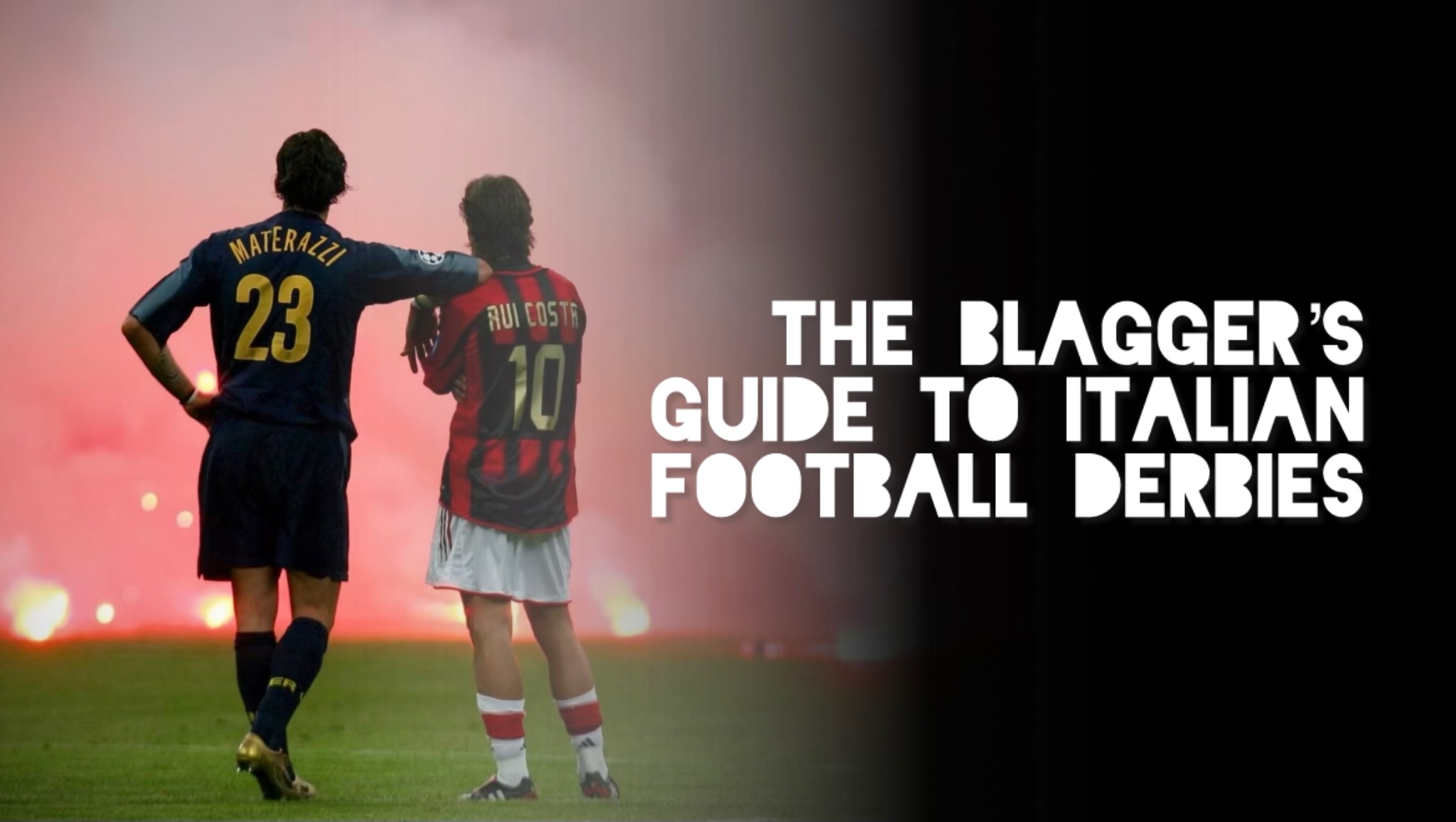
From the Derby della Madonnina to the Derby della Mole, river-deep and mountain-high, Italy is awash with evocatively-named footballing rivalries.
But have you ever wondered where these Italian grudge matches got their names?
Here’s our blagger’s guide to the derbies of Italian football – and the stories behind them
Big City Derbies
Italian football has four big city derbies, most of which are named after famous civic landmarks.
Derby Della Madonnina
The clash between AC Milan and Inter is arguably the biggest fixture in Italian football. The Derby della Madonnina takes its name from the golden statue of the Virgin Mary atop Milan’s Duomo, a symbol that watches over the city.
The origin of the two clubs provides additional grit to the derby. Inter were formed in 1908 by members who split from Milan over a disagreement about the participation of foreign players. The breakaway club embraced an international outlook, hence Internazionale.
The rivalry has swung back and forth over the decades, fuelled by title races, Champions League nights and ownership eras that have reshaped both clubs. Inter currently hold the upper hand in this fixture with 70 Serie A wins to Milan’s 56.
Embed from Getty ImagesDerby della Mole
In Turin, Juventus face Torino in the Derby della Mole, named after the Mole Antonelliana, the distinctive tower that dominates the city skyline. The edifice was originally designed as a synagogue but now houses a museum of cinema.
This is Italy’s oldest cross-city derby; Juventus were originally the club of the bourgeoisie, founded by students from a prestigious school in the city. Not unlike the Milano derby, Torino FC can trace their roots back to disgruntled Juventus members who formed their own breakaway club. Aside from brief spells in the 1940s and 1970s, Juventus have consistently got the better of their rivals, with 78 wins to Torino’s 35.
Embed from Getty ImagesDerby della Lanterna
Genova’s rivalry between Genoa and Sampdoria is the Derby della Lanterna, a tribute to the 16th-century lighthouse that symbolises the maritime city.
Compared to Milan or Turin, this is a relatively modern feud. Sampdoria were formed in 1946 through the merger of Sampierdarenese and Andrea Doria. Yet the intensity is undimmed. Played at the atmospheric Stadio Luigi Ferraris, it’s often one of the most visually spectacular derbies in the country. In Serie A, Sampdoria hold the bragging rights with 31 victories to Genoa’s 19.
Embed from Getty ImagesDerby della Capitale
The Rome derby between AS Roma and Lazio is the Derby della Capitale – the Derby of the Capital. Italian football’s relative scarcity of cross-city rivalries is partly rooted in the Fascist regime’s push in the 1920s to consolidate clubs into stronger professional entities. Roma were formed in 1927 through such a merger of clubs in the Eternal City. Lazio survived independently, thanks to their political connections within the regime.
The rivalry has long carried undertones of identity: Roma traditionally drawing more support from the historic city centre, Lazio with stronger roots in the broader region. Few fixtures in Europe match its volatility or atmosphere. Roma currently have 59 victories to Lazio’s 42.
Embed from Getty ImagesCross-City Derbies
Not all Italian rivalries are about geography. Some are about status.
The Derby d’Italia pits Inter against Juventus – a term coined by journalist Gianni Brera in 1967 to describe the meeting of Italy’s two most decorated and widely supported clubs. Industrial money from Italy’s economic miracle fuelled an intense rivalry that endures to this day. Juventus hold the advantage with 89 Serie A victories to Inter’s 50.
When Roma face Napoli, it’s known as the Derby del Sole (Derby of the Sun), sometimes also referred to as the Derby del Sud. The name references the Autostrada del Sole (motorway) linking Rome and Naples and reflects a period in the 1970s when these clubs were seen as the South’s standard bearers against northern dominance.
The rivalry ebbs and flows with competitive cycles, but it remains one of the peninsula’s most politically and culturally charged fixtures. The record books tell the story of a finely-balanced contest with Roma’s 54 wins to Napoli’s 51.
Embed from Getty ImagesProvincial Derbies
Beyond the bright lights of the major cities lies the true heartbeat of Italian football: provincial rivalry. Fuelled by campanilismo – fierce local patriotism rooted in Italy’s pre-unification city-states – these clashes are often every bit as intense as their metropolitan counterparts.
There are too many to list exhaustively, but here are some of the most evocative.
Derby dell’Appenino, between Bologna and Fiorentina, is regularly contested in Serie A, the most fierce rivalry between Reggio-Emilia and Tuscany, named after the mountain range that separates the regions.
Italy, being Italy, food inevitably enters the chat. Derby del Riso (Rice derby) is contested between Pro Vercelli and Novara, two former powerhouses located in Italy’s rice-growing heartlands. Meanwhile, Derby del Grana (Parma v Reggiana) is played out between two cities that represent the heart of the Parmigiano-Reggiano cheesemaking region.
Water provides a common theme, be that rivers, lakes or the high seas. Starting in the north of the country, we have Derby del Lario (Lecco v Como) between two clubs located on the southern shores of Lake Como. “Lario” is the local name for the lake. Derby del Secchia (Modena v Reggiana), Derby del Po (Cremonese v Piacenza) and Derby dell’Arno (Fiorentina v Empoli) are all named after the rivers that intersect the respective cities.
Continuing out to sea, the Derby del Tirreno (Livorno v Pisa) is a Tuscan rivalry steeped in medieval tradition named after the Tyrrhenian Sea. On the opposite starboard, Ancona v Pescara is the Derby dell’Adriatico. And in the deep south, the Derby del Stretto is named after the Strait of Messina that separates Reggina, on the mainland, from Messina, 15km away in Sicily.
Fond of a derby, Reggina also have Derby della Magna Graecia (Great Greece) v Crotone, recognising the region’s Hellenic history before the Romans arrived, and U Classicu – “The Classic” in Calabrian dialect – against Catanzaro, a match between the two largest cities in the modern Calabria region.
The Derby del Sicilia is contested not by Messina, but by Palermo and Catania, representing the two largest cities on the island, albeit located 200km apart. The city of Naples was once part of the Bourbon Kingdom of the Two Sicilies, so when Napoli meet Palermo, it’s known as Derby delle Due Sicilie. Finally, there is an inter-island derby, Derby delle Isole, contested between Palermo (Sicily) and Cagliari (Sardinia).
Italian football’s derby culture is a map of the country’s history: fragmented, proud, local and fiercely defended. Learn the names, and you begin to understand the landscape. But to understand the passion, you need to watch the games.


 Calcio England