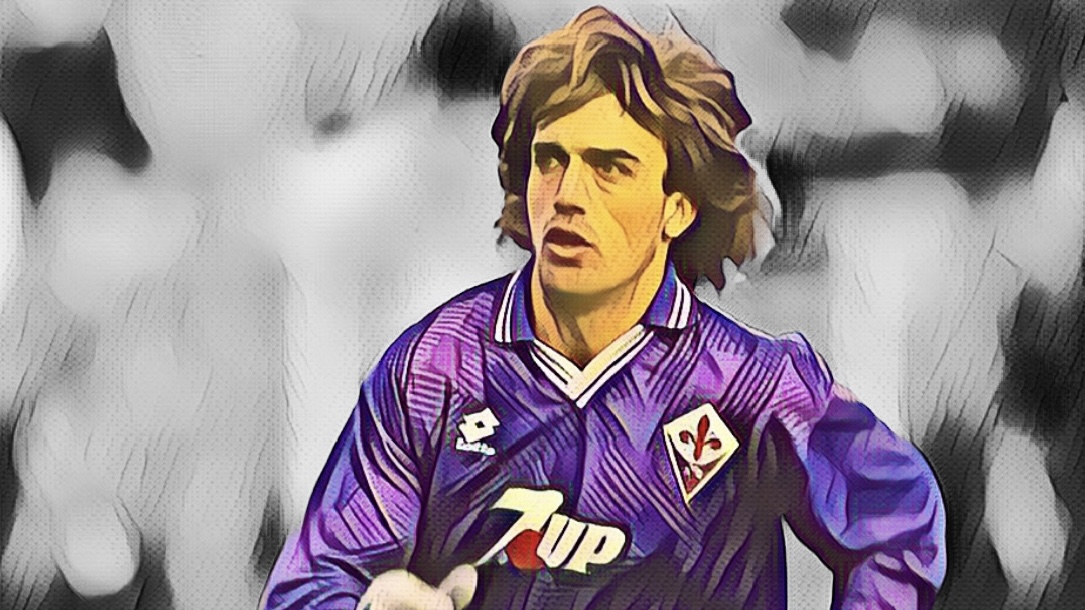
“Florence has not forgotten Batistuta”, declared the city’s Mayor as he conferred honourary citizenship upon the Argentinian in 2016.
Over the course of nine captivating years, the rambunctious Batistuta had become a physical representation of the city of Florence.
He was art and violence. Leonardo Da Vinci meets Calcio Fiorentino. He was beauty and brawn; the precise elegance of Brunelleschi’s Coppola combined with the ruthlessness of the Medicis.
With his trademark billowing mane and hulking thighs, he struck 207 goals in 337 games in the storied Viola shirt. But the legend of Fiorentina’s greatest-ever goal scorer was almost never written.
Following La Viola’s shock relegation to Serie B, and with the 1994 World Cup on the horizon, Batistuta was staring at the prospect of a year touring Italy’s provincial playing fields. Lucca, Ravenna and Acireale were hardly the ideal preparation for the biggest summer of his burgeoning career.
His mind seemingly made up, Batistuta was preparing to leave Florence…until the intervention of Fiorentina’s steadfast President, Mario Cecchi Gori.

Prologue
Back in summer 1991, Fiorentina were continuing to grapple with the creative void left by Roberto Baggio’s controversial departure to Juventus a year earlier.
The latest candidate earmarked to inherit La Viola’s number 10 shirt was Diego Latorre, a diminutive playmaker at Boca Juniors. However, in pursuing Latorre, a swashbuckling young striker caught the eye of Fiorentina.
Gabriel Batistuta’s six-goal haul at the 1991 Copa America tournament was the perfect illustration of his abundant qualities. He began with a poacher’s finish and a clinical penalty against Venezuela. That was followed by powerful strikes against Chile and Paraguay. And then a deft header against Brazil, where his leap seemed to defy the laws of gravity.
Batistuta was a physical paradox. Those muscular thighs gave him a tremendous leap and thunderous shot, yet he could lithely leave opponents trailing in his wake. Combined with his combative style and tireless movement, he had the makings of the complete centre-forward.
Remarkably, Batistuta had only been playing in that position for twelve months. He was primarily deployed as a wide forward at Newell’s and River Plate until the visionary intervention of Boca coach Oscar Tabarez.
Aside from Batistuta’s physical prowess and technical attributes, he also brought an unyielding mentality to the pitch. Naturally, it was he who scored the decisive goal against Colombia that confirmed Argentina as South American champions.
Hellas Verona had been poised to secure Batistuta’s signature ahead of that Copa America tournament. But after a summer in the shop window, the price had increased and suitors from across Europe were now closing in.
La Viola moved heaven and earth to prise 22-year-old Batistuta away from Boca. To close the deal, Fiorentina struck an unconventional 18 billion Lira triple signing of Batistuta and Latorre from Boca, plus Antonio Mohamed from Huracán.
Boca wanted Mohamed to replace Batistuta, so Fiorentina stepped in on their behalf. Latorre and Mohamed stayed in Florence just long enough for the ink to dry on their contracts before making a preordained double loan move to Boca for the 1991/92 season.

Inferno
The opening verses of Batistuta’s story in Florence offered few clues about the legend that would ultimately unfold. A meagre return of just 3 goals in his first 16 matches was disappointing for a player of which so much had been promised. The Florentine public were underwhelmed and unconvinced.
That was, until one bright January afternoon at Stadio Artemio Franchi.
A white-hot Florentine reception awaited their bitter rivals, Juventus, that day. And it was Batigol, not Baggio, that stoked those fires. With just 7 minutes gone, demonstrating his animalistic instinct, Batistuta pounced on a looping ball into the box to nod past the motionless Stefano Tacconi. Fiorentina’s Curva Fiesole was propelled into a state of delirium.
Batistuta’s goal authored a famous victory over the Bianconeri at a time when tensions between the two clubs were running at their peak. From that point, Batigol never looked back as he thumped in trademark headers, volleys and angled drives – thirteen of them in total – during his maiden Serie A season.
The following campaign saw Batistuta cultivate his reputation as a clinical finisher, scoring a goal every other game across the course of the season. However, as Batistuta ascended to new heights, La Viola were encumbered by the most un-Italian of problems.
Only four teams in Serie A had scored more goals than Fiorentina that season, but their potency in front of goal was fatally undermined by a porous defensive line. Three different coaches had tried – and failed – to fix the leaks. Lodged in the bottom four, Fiorentina’s season hinged on a must-win match against Foggia.
The accepted wisdom suggested that Fiorentina were too good to go down. German international Stefan Effenberg patrolled the midfield. Batistuta and his strike partner Francesco Baiano were flanked by the copious talents of Brian Laudrup and Massimo Orlando. Yet it had all come down to this final game.
A 6-2 victory, with Batistuta on the scoresheet, was entirely in keeping with La Viola’s helter-skelter season. However, events elsewhere conspired against them. Udinese, Brescia and Fiorentina finished tied on points and the Tuscans were condemned to relegation based on their head-to-head record.
La Viola’s calamitous relegation brought down the curtain on half a century of uninterrupted participation in Serie A.
His pride dented, President Cecchi Gori set his sights on an immediate return to Serie A. But would his troupe of stars be persuaded to endure a season in the purgatory of Serie B?
Embed from Getty ImagesPurgatory
Soon after Fiorentina’s fate was sealed, the press began reporting that Batistuta was plotting an exit from Florence.
A return to Boca was said to be the player’s preferred destination, whilst there was serious interest within Europe in the form of Bayern Munich and Valencia. La Stampa quoted Batistuta as saying, “I have instructed [my agent] Aloisio to find a suitable arrangement to avoid Serie B. He knows what my needs are and he knows what he has to do”.
Fiorentina allowed Laudrup to depart on loan to Milan but were determined to keep the rest of the band together. The up-and-coming Baiano and Orlando were persuaded to stay with the offer of improved contracts. Meanwhile, President Cecchi Gori doubled down on the wantaway duo of Effenberg and Batistuta. They were bluntly threatened with a year in the wilderness if they failed to return to Florence.
Batistuta’s stance quickly softened in the face of this ultimatum, proclaiming, “I think I have to show gratitude to the club and to the Viola fans”.
But the saga took a further twist in the days that followed. Batistuta was willing to stay, but only on terms that reflected his elevated status within the club. “My salary needs to be adjusted: some of my teammates take more than me”, Batistuta is attributed as saying.
The strong suspicion was that Batigol’s agent was the driving force behind these latest demands, which received short shrift from the Fiorentina hierarchy. Sporting Director Giuliani sharply retorted, “We do not accept negotiations or adjustments, much less blackmail of an economic nature. The only increase we can discuss concerns the number of goals”.
With Batistuta’s negotiating capital exhausted, he was resigned to staying in Florence. Although, he would be absent for the beginning of the new season. He spent the month of June in Ecuador, where his decisive goals in the final helped Argentina to retain the Copa America title.
An intense schedule of South American World Cup qualifying matches throughout August and into September culminated in an embarrassing 5-0 home defeat at the hands of Colombia. This result left Argentina’s World Cup qualification hanging in the balance.
Within a matter of weeks, public sentiment had turned; the euphoria of the Copa America triumph had evaporated and a noxious atmosphere engulfed the national team. At this point, an escape to Europe and Florence, even Serie B, would have felt increasingly appealing for Batistuta.
Paradise
By the time Batigol pulled on the famous Viola jersey once again, Fiorentina were already unbeaten in four matches and sitting at the top of the Serie B standings. A summer of rumour and discontent and his subsequent absence had undoubtedly strained the relationship between Batistuta and the Tifosi. A goal against promotion rivals, Brescia, in his first game back, began to heal those wounds.
Any lingering doubts about Batigol’s commitment to the cause were emphatically extinguished a fortnight later. A hat trick in the Tuscan derby against Pisa marked the reconciliation between Batistuta and the Florentine public. His third, a powerful acrobatic strike, was straight from the Batigol playbook.
Batistuta was predictably flourishing against the inferior defences of Italy’s second tier. In between trips to Australia, Argentina and Brazil to fulfil his national team duties, Batistuta claimed 16 goals in 26 Serie B matches.
He even tasted European football, although not of the variety he might have anticipated when he first arrived from Buenos Aires. Fiorentina’s relegation meant entry into the Anglo-Italian Cup and the opportunity to see whether Batistuta could indeed do it on a cold Wednesday night in Stoke.
Batistuta signed off on a truncated domestic season at the beginning of May with a brace of goals in a 5-1 victory over Ascoli. With four league games remaining, Batistuta had delivered Fiorentina to the brink of a Serie A return. He departed for Argentina’s World Cup camp, leaving his team-mates to finish the job in Italy.
Embed from Getty ImagesEpilogue
After a year touring Italy’s footballing backwaters, the 1994 World Cup presented the opportunity for Batistuta to shine on the global stage once again. He grasped that opportunity with a four-goal haul, although Maradona’s doping controversy and Argentina’s humbling last-16 elimination cast a long shadow over any sense of personal accomplishment.
It was an act of satire that the architect of Argentina’s elimination was a player dubbed Maradona of the Carpathians. Gheorghe Hagi had walked an almost identical path to Batistuta over the preceding twelve months; suffering relegation from Serie A with Brescia, before fighting on for redemption in Serie B. Whilst Fiorentina had beaten Brescia to the Serie B title, it was Hagi and Romania that previled under the intense heat of the Pasadena sun.
This forgotten chapter of Batistuta’s career laid the foundations for an enduring love affair between player and city. The adversity of relegation and the bitterness of his threatened departure, once overcome, only served to strengthen those bonds.
Even Batistuta’s ultimate and acrimonious departure to Roma in 2000 only temporarily dimmed that love. In such instances, actions speak louder than words; the tears that rolled down Batistuta’s cheeks when he scored against La Viola transcended mere sporting affinities.
Thanks for reading! If you enjoyed this, check out the story of the 1990s Anglo-Italian Cup, featuring Batistuta and Fiorentina.


 Calcio England
Great memories of Batigol thumping in howitzers from everywhere in Serie A – a good read, thank you.
LikeLike