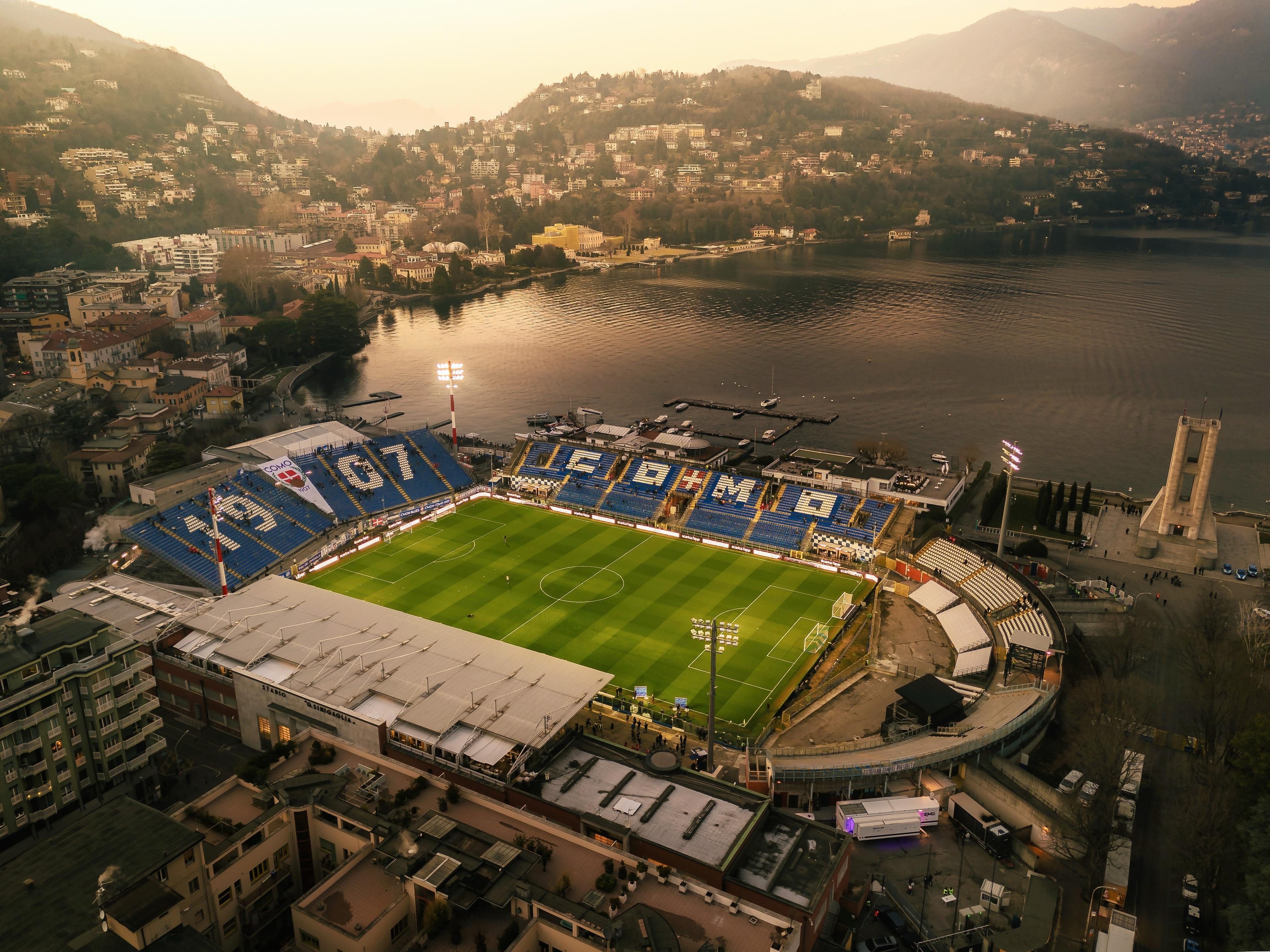
Como can lay claim to one of the most idyllic stadium settings in European football: a ground perched on the shores of Lake Como, with steep, verdant hills rising dramatically from the water’s edge. It’s a backdrop that has become central to the club’s identity under their billionaire Indonesian ownership.
Yet as Como’s meteoric ascent continues, the stadium is beginning to lag behind the team it represents.
Celebrating its centenary next year, Stadio Sinigaglia has already undergone significant upgrades. In summer 2024, works were completed against the clock to bring it up to Serie A standards; they just about made it with some discretion applied by the league. Further work last summer saw incremental improvements, especially to the away sector.
Now, with Como on the brink of European qualification, a far sterner test looms. UEFA will not offer the same leeway. Whether the club finds itself in the Champions League, Europa League, or Conference League, the regulatory bar must be met – and UEFA inspectors have already visited in April to assess the ground’s suitability.
Embed from Getty ImagesThe most significant issue is the vast temporary scaffold curva that houses Como’s ultras. UEFA regulations are clear; “stands must be fixed to a load-bearing foundation and may not be based on or contain any tubular/scaffolding structures”.
Club president Mirwan Suwarso, backed by the city’s mayor, has outlined plans to replace the curva with a permanent structure this summer, with the aim of having it ready before any potential European fixture.
Time, however, is in short supply. Como’s final Serie A home game is scheduled for 17 May, while their earliest possible European fixture could fall on 20 August in the Conference League play-offs. A Champions League or Europa League berth would buy them a few extra weeks – until mid-September – and a favourable draw that sees them play away first could extend that window into October.
Even so, a three- to five-month turnaround for such a project looks ambitious, if not improbable.
Then there’s the pitch itself. Over the past year, Como have already expanded its width from 65 to 66 metres at the request of head coach Cesc Fàbregas. UEFA, however, mandates a minimum width of 68 metres for Category 3 and 4 stadia, along with a two-metre buffer between the touchline and advertising boards. That leaves very little room for adjustment within the current footprint.
Beyond these headline issues lies a longer list of compliance requirements, covering everything from parking and medical infrastructure to floodlighting and media facilities. Collectively, they represent a substantial logistical challenge.
Should these hurdles prove too great, staging matches outside of Como becomes the only realistic fallback. The likely destination would be the Mapei Stadium in Reggio Emilia, home of Sassuolo, which has previously hosted Atalanta’s European fixtures when their stadium was undergoing redevelopment. Udinese’s Bluenergy Stadium has previously been discussed as an alternative too.
For Como supporters, games in Reggio Emilia would mean a round trip of roughly 500 kilometres, around six hours on the road. It is far from ideal, but perhaps a compromise softened by the exoticism of European nights and the promise of an eventual return home.
Ordinarily, this would feel like a foregone conclusion in Italian football. But Como are not a typical Italian club.
With deep-pocketed owners and a cooperative relationship with the local municipality, European football being played on the shores of Lake Como next season remains a very real possibility – even if only for part of the campaign.


