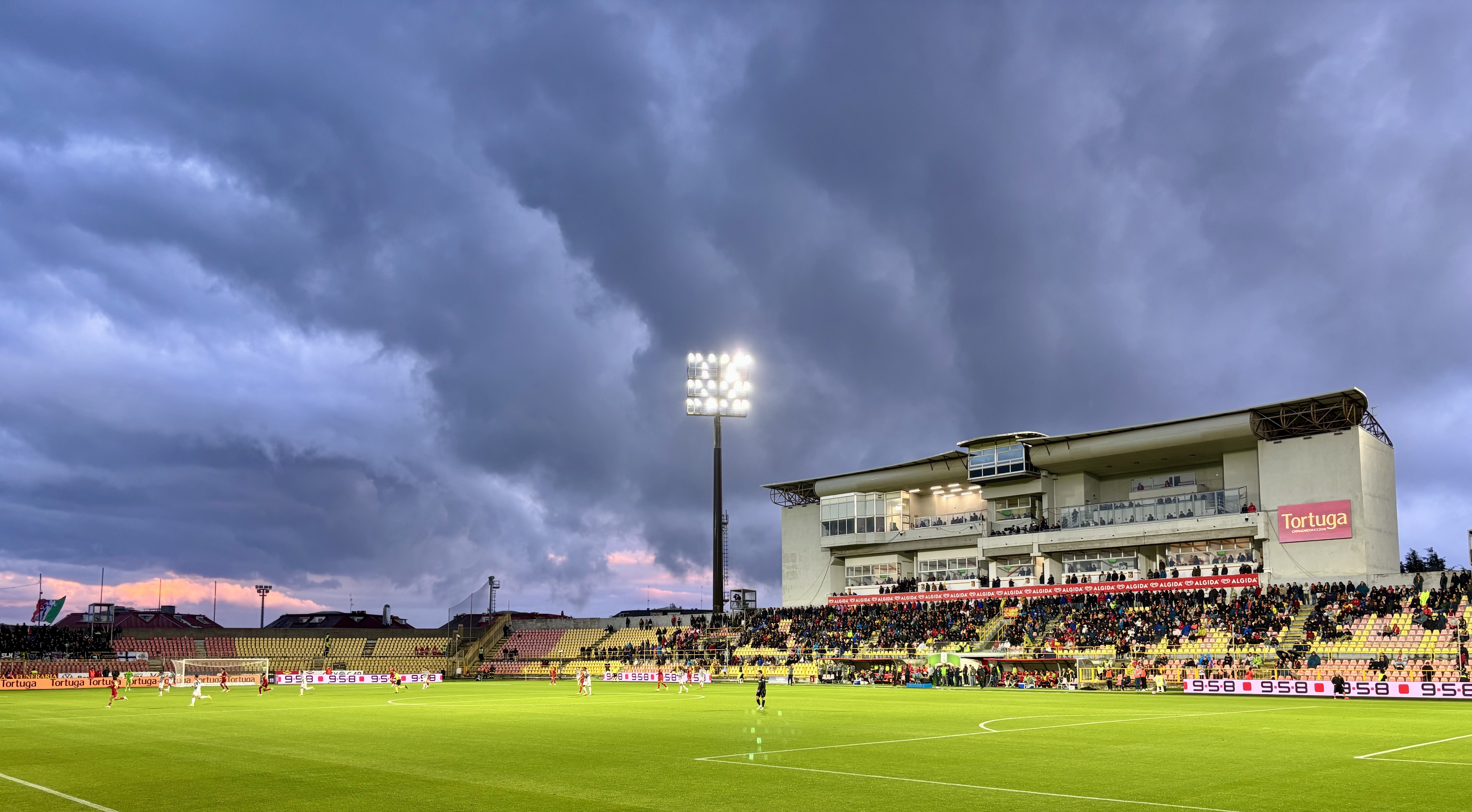
Perched on a rugged ridge between the forests of the Sila National Park and the Ionian Sea, Catanzaro feels like a frontier town. It is also home to the southernmost professional football club on mainland Italy.
For centuries, the city’s elevated position and proximity to the coast made it a stronghold for whichever power happened to dominate southern Italy; Saracens, Normans, Catalans and Venetians all left their mark on the territory.
The city’s most famous landmark is the Viadotto Fausto Bisantis, a breathtaking single arch bridge that sweeps 120 metres over the valley floor, linking the historic centre to the newer northern districts.
The Club
US Catanzaro are a symbol for the wider province; with their nearest rivals Cosenza, Crotone and Reggina all located more than an hour away, I Giallorossi supporters are drawn not only from the city itself, but the wider towns and villages in its orbit. The club’s red and yellow colours and golden eagle emblem are all taken from the city’s flag.
Catanzaro’s golden age arrived in the 1970s, when the club spent five consecutive seasons in Serie A. Claudio Ranieri made more than 200 appearances in the Giallorossi defence before embarking on the managerial career that would eventually make him one of Italian football’s most recognisable figures. Half a century later, those years remain the benchmark against which every Catanzaro side is measured.
Inevitably, the good times could not last forever and for every high point there must be a corresponding low. Or two in Catanzaro’s case. Successive bankruptcies in 2006 and 2011 required the club to twice re-start from the fourth tier.
Recent years have brought both optimism and success, with promotion to Serie B in 2023 followed by an unlikely push for a return to Italy’s top table. Catanzaro have reached the Serie B play-offs in three consecutive seasons – agonisingly missing out last season under Alberto Aquilani, drawing the two-legged final with Monza 2-2, but losing out as the lower placed team.
Veteran forward Pietro Iemmello is the talisman of the current team. A Catanzaro native, he joined his hometown club at the age of 30 and has averaged just under a goal every other game in the four years since. However, the captain has his work cut out after a difficult start to the 2026/27 campaign.
The Stadium
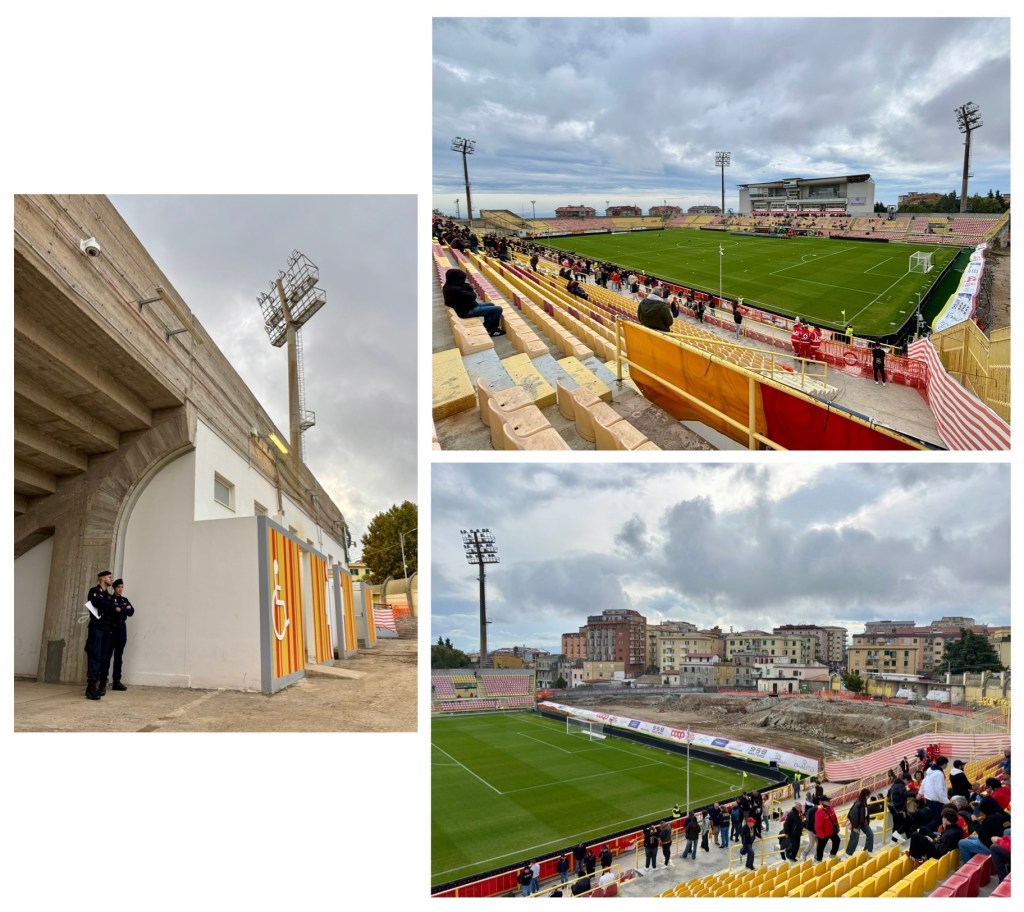
Stadio Nicola Ceravolo has one of the most unusual settings in Italian football, located in a historic residential district in one of the highest points of the city. It’s a testing uphill walk (around 2km) from the historic centre, rising rapidly through the narrow streets. More than once I found myself checking Google Maps for reassurance that we were still on the right track.
Established as a military venue in 1919, its claim to be Italy’s third oldest football stadium (behind Genova and Venezia) is somewhat debatable, as it was only transformed into a municipal sports venue later in the 1920s.
Stadio Ceravolo was expanded in the 1970s, reflecting the football club’s rapid rise to prominence. The largest recorded attendance came in 1982; officially 29,000 were present, unofficially many more, as Juventus clinched the Scudetto courtesy of a Liam Brady penalty.
An enduring image of the stadium from that era was the maritime pine tree behind the Curva Ovest, leaning into the ground as though craning for a better view of proceedings while simultaneously providing shade for Catanzaro’s ultras.
In 2016, the stadium received its first significant investment in many decades when a peculiar new structure was built directly behind the Distinti side. The imposing new edifice – housing changing rooms, press and hospitality facilities – looms over the old terrace. It has the feel of an adjacent tower block rather than a part of the stadium, with an oddly sparse use of the pitch-facing side of the building.
The capacity stood at 14,500 before a further overhaul began in the summer of 2026. The Curva Ovest will be rebuilt closer to the pitch, whilst the main Tribuna will be upgraded with a new cantilever roof. As of autumn, however, optimism has yet to translate into visible progress. The stadium resembles a building site, with the Curva Ovest reduced to rubble and the ageing Tribuna exposed after the removal of its old roof.
The Experience
We’d planned to spend a couple of hours exploring the historic centre before kick-off, but quickly discovered that Catanzaro still observes the traditional southern Italian pausa with admirable dedication. The centre was eerily quiet, besides the occasional hum of a passing scooter. Even the club shop – on a Saturday afternoon a few hours before the match – was closed.
On the long trek up to the stadium, we passed several small bars with red-and-yellow-clad supporters spilling onto the street, each one appearing to offer a tempting excuse to abandon the ascent. We resisted until reaching the ultras’ HQ in the appropriately named Piazza Fratelli Bandiera. By now, the steep streets had begun to take their toll; calves were burning, beads of perspiration were forming under our clothing…and €2.50 seemed a bargain for a bottle of Peroni. Despite the dark clouds gathering overhead, we discarded our jackets and took a few minutes to catch our breath before tackling the final stretch.
From there, we kicked on up the final part of the hill, rounded the corner to be greeted by the welcome sight of floodlights peering above the roofline. Behind the Curva Ovest, Via Francesco Paglia provides a gathering point for fans; there’s a bar, a ticket office, an unofficial merchandise stall, free programmes being distributed and a recently-unveiled statue of former star Massimo Palanca.
With the Curva Ovest currently out of action, we secured tickets (€19) in the West side of the Tribuna, the temporary home of Catanzaro’s ultras. Patience was required as they only went on sale four days before the game, via Ticketone.
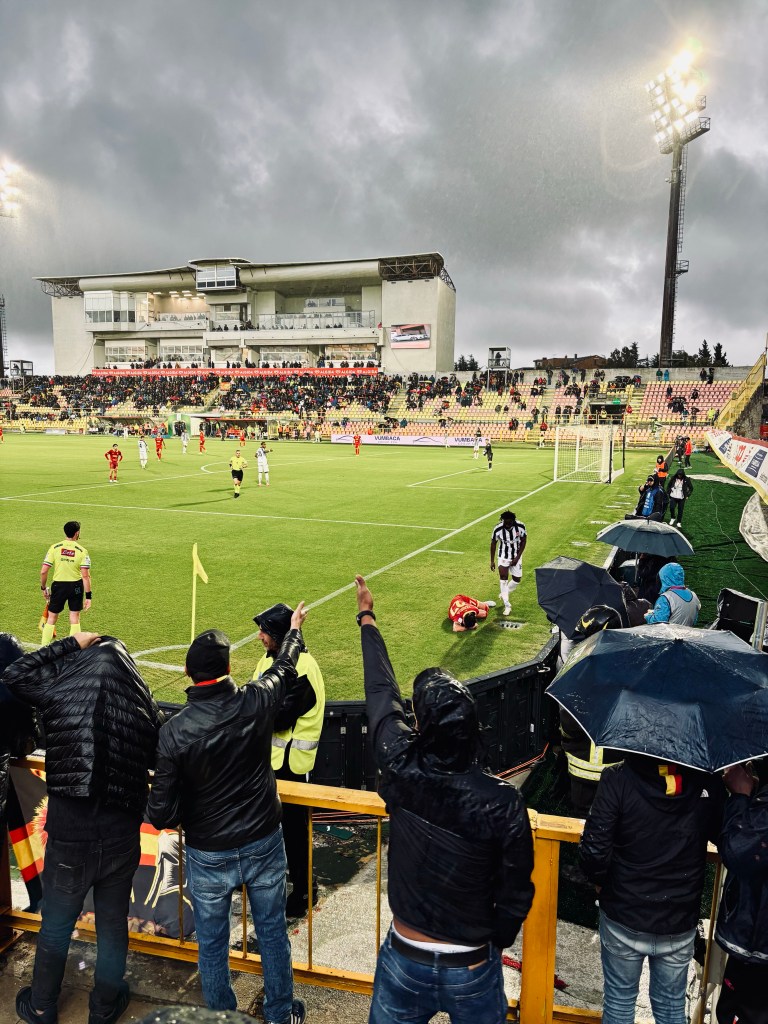
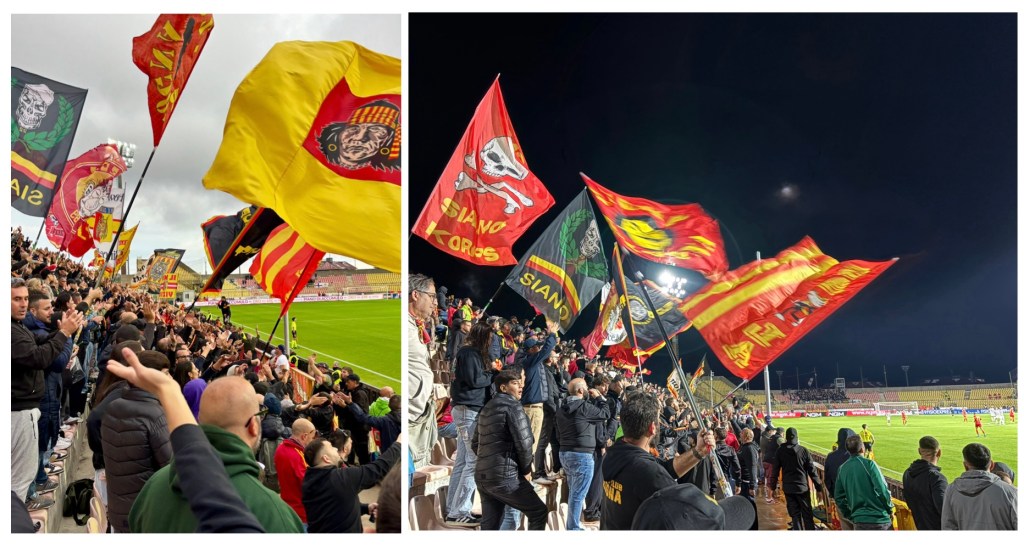
The sporadic rain showers, combined with the lack of cover, did little to dampen the enthusiasm of Catanzaro’s hardcore support. The capo ultra orchestrated from the front of the terrace – a position unusually close to the pitch given the lay out of the stadium. As kick-off approached, the battalions of flag-bearing ultras filed in and began taking their instructions.
The facilities at this work-in-progress stadium can best be described as rudimentary. The bar is tucked in behind the Tribuna, taking advantage of the only bit of shelter available, offering the usual range of beer (€5), soft drinks (€3) and crisps. Aside from that, you can make your own fun by heading to the top step of the Tribuna, where the deep blue of the Ionian Sea comes into view behind the Curva Est.
Catanzaro had made a disastrous start to the 26/27 season and coach Giorgio Gigone’s employment was hanging by a thread going into the game with Ascoli. His team could not have got off to a better start as they took the lead midway through the first half. But that marked the high point of the afternoon for Catanzaro.
Ascoli equalised and then took the lead in quick succession. Catanzaro’s belief visibly ebbed away and by the time half time arrived they were trailing 4-1. The crowd became battered by the increasingly heavy rain and wind forcefully sweeping through the stadium – it was a miserable afternoon for anyone of a red-and-yellow persuasion. Ascoli scored twice more to round off a compelling victory. The ultras defiantly continued to offer their support, right up to the final whistle when a chorus of piercing whistles and howls cut through the air.
Catanzaro feels like an outpost of Italian football, but if anything that sense of isolation only intensifies the attachment of its supporters. We didn’t encounter the club at its best; the stadium was half-demolished, the team were heavily beaten and the weather was dreadful. Yet somehow, that only made the experience more memorable.
Thanks for reading our travel guide – you can find guides for other cities here, along with tips and advice for planning your next Italian football getaway.


